Aging

Mary Ann

When I was in 9th grade, we read Shakespeare’s As You Like It.  We had to recite the famous speech, All the World’s A Stage, in front of the class.  It was a piece that took an individual through the various stages of life comparing it to a play.  For the most part, I didn’t get it.  If you hadn’t lived a particular stage, you couldn’t identify with it.  And what in the world did sans teeth, sans eyes, sans taste, sans everything mean? 

Well, as one ages, the various stages begin to make sense, and now, that I am in the final stage of the speech, I know what sans, French for without, means and indeed it is true. I always thought that there should be a T-shirt that says, “Aging is Not for Sissies.”  You must be tough to grow old.  There is a challenge around every corner, a surprise just awaiting you.

Aging is full of aches and pains.  You discover body parts you didn’t know existed.  You develop health conditions like hypertension, cholesterol, or diabetes. Your body does not want to do what your head tells it to do.  You can’t open the peanut butter jar.  It is hard to go up the steps or getting out of a chair.  You can’t see as well as when you were young.  You can’t hear either, so you say what a lot. You forget names, and words just sit on the tip of your tongue. There are lots of thingmajigs or whatchacallits in your vocabulary now.  You have many senior moments.  The list could go on and on, and it keeps growing with the passing years.  Mark Nepo has said, “The terrain of aging is steeper the longer we go.”  Amen!  

As challenging as aging is, there are many good things that can only be acquired with growing older.  There are lessons to be learned with the passage of time.  With aging you gain wisdom and experience.  Life is always teaching you a lesson.  You gain understanding and patience from those lessons.  You grow to appreciate stillness and the peace that it brings.  You begin to understand that taking the time to smell the roses is what life is all about.  You embrace the life you have and live acceptance.  You discover your inner light and let it shine.

We know that change is inevitable.  It is one thing that you can count on.  Yet, it is still hard to embrace as you grow older. The changing is getting us ready for the final journey whatever it will be.  Again, I quote poet Mark Nepo whose beautiful words explains the coming adventure.  “It’s as if my body is a nest and my soul is a bird who has waited a lifetime for the moment it can fly away.”  Aging prepares us for that final flight.

I wrote this essay for the journaling group that I recently joined.  The topic was aging, and I based some of it on the work of Mark Nepo.  He is a poet and spiritual writer who I just discovered.  His prose is lyrical and so deep that you pause after many of his sentences to ponder the wisdom that Nepo imparts.  His most recent work is The Fifth Season, Creativity in the Second Half of Life.  Nepo is now in his seventies, and this book echoes his many years of a reflective life.  My friend Lisa and I read the book as part of our nonfiction book club.  After the first section, we decided to do a slow read of this book.  Each section has four or five chapters that each end with a journal prompt and a discussion question about the reading.  This was a great jumping off point for Lisa and me to discuss the reading. We decided to read one section a week and then take a second week to reflect on what we read.  That is how rich the readings were.  I took notes throughout the various sections, and we reviewed our thoughts when we finished the book.  I don’t believe I have ever put that much energy into reading a book.  However, it was worth every minute.  Since both Nepo and I are in our fifth season, I could recognize myself throughout the book.  We are all traveling on the same path but in our own unique way.  I am thankful I got to join him on his. 

Lisa and I would highly recommend this book, but it is not a quick read even though the book is only 200 pages.   You need to take your time and digest Nepo’s beautiful words.  It is nourishment for the soul. It is a book to return to again and again gaining insights into one’s inner life.  I am also reading Nepo’s bestselling book, The Book of Awakening, that is a year’s worth of daily readings.  He wrote it 20 years ago, and it is still very relevant.  Many people read it year after year.  I think I will too.  Each day is ended with mediations to reflect upon the wise words Nepo shares.  If you would like to hear more about Mark Nepo and his books listen to Mel Robbins’ Podcast from November 16, 2025 – The Exact Words You Need to Hear Today If It Feels like Nothing’s Working.  Mel is a big fan of Mark.  I hope that you will join his fan club along with me!  
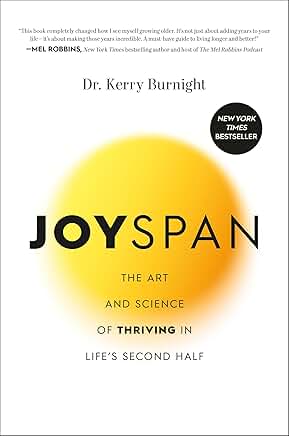
Joyspan

Mary Ann

As you know, the Silver Sage Sisters have written frequently about life in retirement and growing older.  We have tried to share with you good books and ideas to help you ease into this chapter of your lives. I have recently come across a book that I think you would like.  It is Joyspan – The Art and Science of Thriving in Life’s Second Half and is written by Dr. Kerry Burnight who is known as America’s Gerontologist.  She believes in optimizing dignity, health, and joy with aging.  

Burnight defines joyspan as the experience of well-being and satisfaction in longevity.  She states further that joyspan requires knowledge, intention, and effort and is achievable regardless of where you are starting out today.  Thriving in old age means to live a fulfilling, purposeful, and satisfying life despite the challenges that accompany aging. You must maximize physical health, cognitive function, emotional well-being, social connections, and sense of meaning.  

In Joyspan Burnight determined four essential elements about aging that include the following:

  1. Grow: Continue to explore and expand
  2. Connect:  Put time into new and existing relationships
  3. Adapt: Adjust to changing and challenging situation
  4. Give: Share themselves

As you grow through the second half of your life, focusing on these four tenants will help you find meaning.  The book goes into great detail about all of them.  There are excellent surveys to help you determine where you are with them and great examples of each in action.  

Joyspan is written by a gerontologist who understands aging, not just the medical aspect.  Dr. Burnight does not dismiss you because you are older.  She respects you and that is often rare in the medical field.  It is a special doctor who takes time to listen to you and is willing to work with you.  Aging is a partnership between the doctors and the patients.

As you know, my friend Lisa and I have had a non-fiction book club for the last six years, and Joyspan has been one of our favorite books.  I have given it to several friends to help them figure out their journey with aging.  Lisa and I have read numerous books on every aspect of aging, and Joyspan tells the good, the bad, and ugly of it all.  It is full of relatable information that everyone in their golden years can use.  Joyspan is a book that I will return to again and again.  I hope that you will find it a treasure as well and will help you age with grace.  

Laughter – A Best Medicine

In the past I was always trying new things.  I took classes, seminars, and lots of certifications, many of which were not at all closely related to my profession.  One such certification was Laughter Yoga.  I had so much fun learning about the value of laughing.

Your body does not know the difference between contrived laughs and laughs generated from humor. The physiological mechanisms such as inhaling, exhaling, and muscle movement are the same. So creating laughter is easy and anyone can do it.  Laughter yoga is particularly effective for people who might not feel like laughing. People who struggle with depression, cancer patients, etc. can be taught to simulate laughter.

Dr. Michael Miller, a cardiologist and medical professor at the University of Pennsylvania posits a hearty laugh is good for your heart, immune system, and additional health benefits. Even from the time of ancient Greeks to the present people have studied the use of laughter. Gelotology, the modern study of laughter, began emerging in the 1960s when many of us were mere children, who laughed spontaneously. Why as adults did we lose the ability to laugh easily? Jenny Rosendhal, a senior researcher of medical psychology at Jena University in Germany found that laughter-inducing therapies decreased glucose levels, as well as cortisol and chronic pain. Now that’s something for us to consider as we begin experiencing the aches and pains of aging!

While it feels a bit awkward at first, you will find that when you start with saying “hee hee ho ho ha ha ha” repeatedly your mouth begins to turn up and before you know it you are in a full belly laugh. (I know you are trying it right now as you read this post!).

One way to laugh more is to get with another person. Look into each other’s eyes and repeatedly say “ha ha” for at least a minute. Before you know it, you will laugh aloud. Of course there are additional techniques that stem from laughter yoga classes. Yet the decision to laugh is contagious, even if it is just for yourself. Look into a mirror and make faces while making laughing sounds.  If those don’t work, try calling a friend.  Tell “dad” jokes. Agree to laugh.

Make laughter a part of your daily routine. The more you laugh, the lighter you will feel. And with that big smile across your face, people will wonder what you are up to!

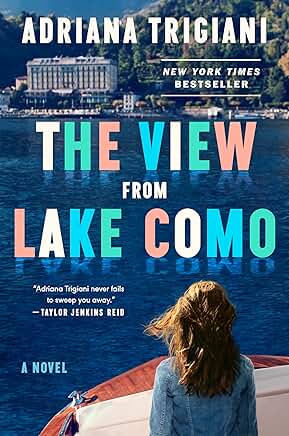
The View from Lake Como 

Mary Ann

Have you discovered the Adrianna Trigiani universe of books?  If you have, you know her wonderful stories and are probably like me waiting for her next book.  If you do not know this author, you are about to make a new friend with Adrianna.   I envy you a bit to have the opportunity to discover this masterful storyteller’s tales. 

Adrianna Trigiani is an author who writes about her Italian heritage from Big Stone Gap in the Appalachian Mountains of Virginia to Greenwich Village in New York City to New Jersey and Italy. The heroine of her books are often women finding themselves and are on the verge of blooming into the strong women they were meant to be.  Their journeys unfold in small towns to big cities, and Trigiani will frequently tell the stories in trilogies, so you really get to know the characters well. You kind of grow with them too.  If you know Italian families, you will appreciate the dialog and biting humor of the families. Trigiani captures it all in her novels.

Since 2000, she has written 19 books – mostly fiction but she does do some nonfiction.  Her most recent book from 2025 is The View from Lake Como, the Jersey version, not the Italian lake; however, Italy becomes a main character in this story.  Giuseppina (Jess) Capodimonte Baratta, the heroine, is a woman who is finding herself.  Jess has endured several hardships with a death of a beloved uncle, a divorce, a controlling family, an unfulfilled career, and the other ups and downs of life.  She wants more from her small life in Lake Como, so she goes to Italy to find herself and what a new life could bring.  Jess is spreading her wings, and you get to join her on the flight!   We all see ourselves in Jess’s transformation, and you may learn a little about yourself as you accompany Jess on her adventure. 

I know that once you read one of Adrianna Trigiani’s stories, you will seek out her other books to be part of her one big Italian family throughout the world.  More importantly, you will be part of her big literary family as well enjoying her tales that are full of heart and soul!   

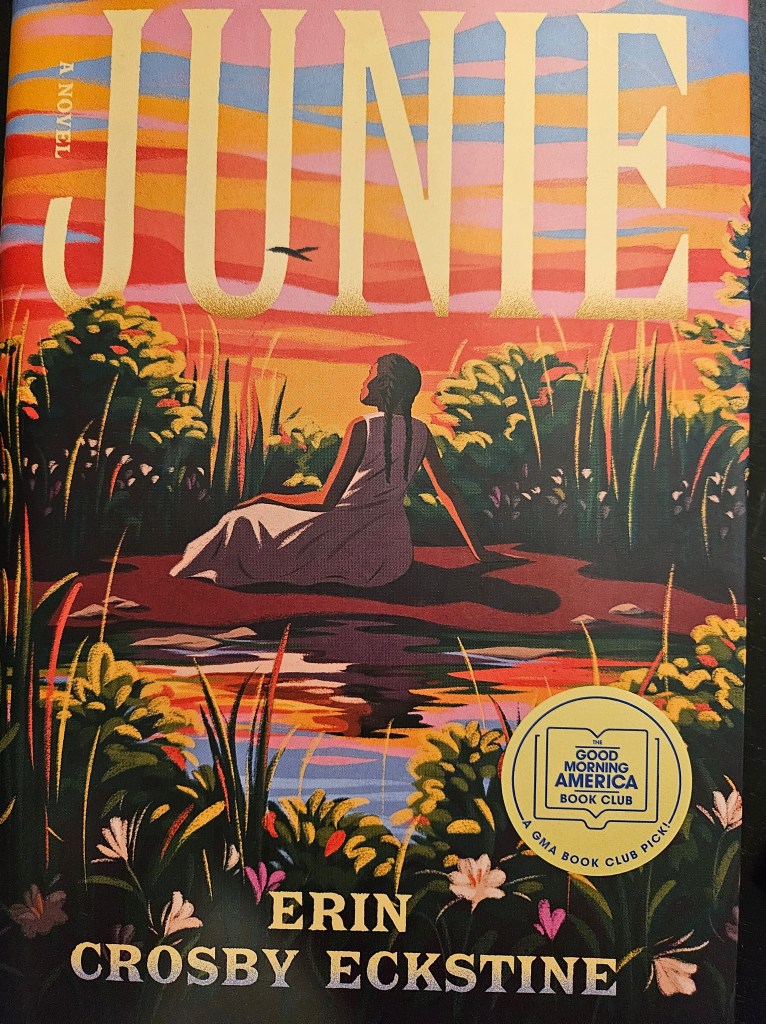
Junie

“JUNIE,” by Erin Crosby Eckstine, is a compelling literary work of historical fiction that delves into the complexities of family ties, personal identity, and the enduring spirit of its protagonist. With a narrative that is both heartfelt and evocative, Eckstine creates a world that is at once intimate and universally relatable, drawing readers into the emotional journey of Junie herself.

The story centers around Junie, a young woman navigating the turbulent waters of slavery, adolescence, and early adulthood. Set primarily on a struggling plantation, the novel explores themes of belonging and alienation as Junie grapples with family secrets, shifting relationships, and the challenges of self-discovery. Eckstine masterfully weaves together past and present, allowing readers to uncover layers of Junie’s history and the factors that have shaped her worldview.

Eckstine excels in this novel with her character development. Junie is portrayed with remarkable depth, her vulnerabilities and strengths both realistic and endearing. Supporting characters—family members, friends, and romantic relationships —are equally well-drawn, each contributing to Junie’s growth in meaningful ways. Eckstine’s empathetic approach ensures that even secondary characters feel authentic, their interactions with Junie serving as catalysts for pivotal moments in the narrative.

Eckstine’s prose is lyrical yet accessible, balancing poetic descriptions with straightforward dialogue. Some reviews felt the first of the novel moved too slowly, however, the novel’s pacing allows for reflection, giving readers space to consider the emotional weight of Junie’s experiences. The pacing allows for deeper characterization. Central themes include the search for identity, the importance of forgiveness, and the resilience required to overcome adversity. Eckstine also touches on issues such as generational trauma and the power dynamics within families, offering thoughtful commentary without becoming didactic.

The book excels in its emotional resonance and authenticity. I found myself rooting for Junie, invested in her struggles and triumphs. Eckstine’s ability to evoke empathy is notable, making the narrative both moving and memorable.

Overall, “JUNIE” by Erin Crosby Eckstine stands out as a beautifully rendered exploration of family, identity, and resilience. The novel’s introspective tone, strong character work, and nuanced handling of difficult themes make it a rewarding read for those who appreciate literary historical  fiction with heart and substance. Eckstine’s debut marks her as a promising voice, and “JUNIE” is certain to resonate with readers long after the final page is turned.

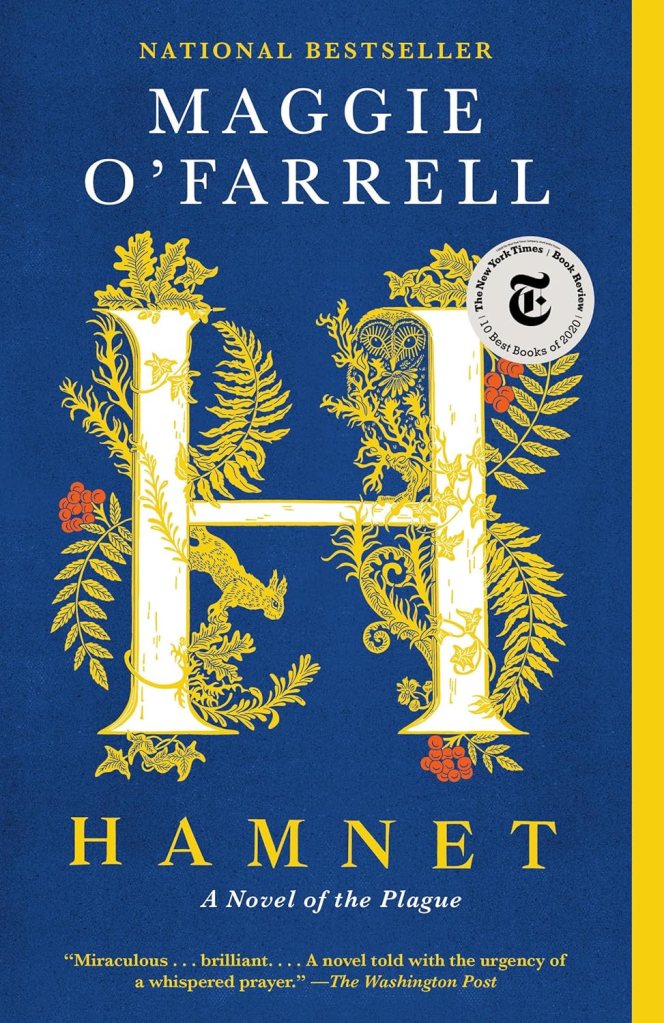
Hamnet

Mary Ann

It is that time of year when we hear Oscar Buzz, and this year is no exception.  Hollywood saves the best for last with films debuting at the end of the year and the beginning of the next. The holiday audiences boost sales, and the films get lots of exposure. Whispers of excellence, however, began to stir in November about a movie with a rather odd name, Hamnet.  Did they misspell Hamlet?  Kind of….

As I began to read more about it, I discovered that the movie is adapted from a novel by Maggie O’Farrell, so I hurried to read it before the movie premiered. Hamnet the book is about the early life of William Shakespeare and his love story with Agnes Hathaway.  The story doesn’t tell you that it is Shakespeare, but you know, and Agnes is not a new character because you know her as Anne.  The tale is based on facts, but as with all historical fiction, the imagination weaves the possible dialogue and circumstances.  The book is a fast read, and you intimately experiences all the emotions (lots of ups and downs) the characters experience as they live life.  I think Shakespeare would approve how the story unfolds.

The hardest part of writing reviews is that you don’t want to tell too much of the story to ruin it for the reader and not telling enough to dull interest to read or to see the movie or whatever.  So, I was ready when the advertisements began for Hamnet.  The trailers tease and then you want, you must see the movie!

Hamnet the movie, is just, in a word, beautiful.  The sets, the scenery, the engaging and attractive actors, the charming children, and on and on.  It all sets the stage for a story of love and loss and eventually healing. The movie is true to the book.  Hamnet didn’t last very long in the theaters.  Most films don’t run long anymore unless it is a blockbuster with dinosaurs or a slice of the Marvel Universe.  Eventually, Hamnet will come to one of the streaming services, or it may have a relaunch should it get an Academy Awards nomination. Regardless, both the book and the movie are worth your time.  It is literature and film at its best.  Enjoy! 

Remarkable Bright Creatures

Mary Ann

Is it Octopi or Octopuses?  I think it both.  However, you currently see many movies, documentaries, and books about the Octopus.  They are everywhere.  Octopuses are very interesting animals and have been documented by many ancient cultures.  They have fascinated humans for the ages.  

The recent bestselling book, Remarkable Bright Creatures by Shelby Van Pelt captures the magic of this mesmerizes animal.  This debut fiction by Van Pelt tells the story of Tova Sullivan, a 70-year-old widow who works as a cleaning lady at the Sowell Bay Aquarium.  She is keeping herself busy after the recent loss of her husband.  She has always kept herself busy ever since the mysterious death of her son, Erik.

While she cleaned, she was watched by Marcellus, a giant Pacific octopus. Marcellus is a wily mollusk, and every few chapters, he charms the reader with his perspective on the ever-unfolding story.  Late at night, Marcellus escapes his tank and gathers treasures left by tourists.  He then hides them in his grotto in his tank. Eventually, Marcellus and Tova become friends. She saves him one night!

The story progresses when a young man, Cameron, comes to live in the community.  There are lots of subplots to the story, but they all come together in the end when the dots are connected. You will have fun putting it all together, so I don’t want to give too many details. 

Remarkable Bright Creatures is a delightful book, and everyone I know who love a good story have thoroughly enjoyed this tale.  I highly recommend this book.  It will lift your spirits! I hope Shelby Van Pelt will share her talents again with future books.  Can’t wait!

Note:  A movie based on the book is being produced with Sally Fields as Tova – a role made for her. Her range of emotions will help us interpret the story so we can all feel Tova and Marcellus’s lives.  

The Lost Bookshop

The Lost Bookshop by Evie Woods is a captivating novel that weaves together elements of historical fiction, mystery, and a touch of magical realism. The narrative unfolds across multiple timelines and perspectives, inviting readers into a world where books hold secrets, and the past continually shapes the present.

At the heart of The Lost Bookshop lies the story of Martha, a woman escaping her troubled past, who stumbles upon a mysterious bookshop in the heart of London. The shop, filled with rare and forgotten tomes, becomes a sanctuary and a puzzle. As Martha delves into the shop’s history, she discovers the intertwined stories of Henry, a bookseller from the 1920s, and Opaline, a woman from the 19th century with a passion for forbidden literature. The narrative unfolds in alternating chapters, gradually revealing how these characters’ lives are linked by the legacy of the bookshop and the enduring power of stories.

Each character in the novel is vividly drawn and richly complex. Martha’s journey from vulnerability to empowerment is particularly compelling, as she confronts personal demons and uncovers her own strength. Henry’s arc is one of quiet resilience, as he navigates societal expectations and personal loss. Opaline’s story adds depth and historical perspective, highlighting the challenges faced by women who dared to defy convention. The supporting cast—fellow bibliophiles, adversaries, and enigmatic figures—add color and intrigue to the narrative.

The author excels at evoking a sense of place. The bookshop itself almost becomes a character, with its labyrinthine rooms, creaking floorboards, and shelves bursting with forgotten wonders. The shifting settings—from Victorian England to post-war London to modern times—are rendered with careful detail and atmospheric prose. Readers are transported into dusty archives, candle-lit parlors, and rain-soaked city streets, fully immersing them in the story’s world.

A central theme of The Lost Bookshop is the transformative power of literature. Books are portrayed not just as objects, but as vessels of memory, rebellion, and hope. The novel also explores themes of identity, belonging, and the ways in which the past haunts the present. The author’s writing style is lyrical yet accessible, blending suspenseful plotting with moments of quiet reflection. The use of multiple timelines and perspectives is handled deftly, ensuring that each narrative thread enhances the overall tapestry.

The Lost Bookshop is a love letter to bibliophiles and an ode to the resilience of the human spirit. It invites readers to question what they value, and to consider the stories that shape their own lives. The novel’s conclusion is both satisfying and bittersweet, tying together the fates of its central characters while leaving space for wonder and interpretation.

Overall, The Lost Bookshop is a beautifully crafted, emotionally resonant novel that may linger with readers long after the final page. I found the characters “stuck with me” long after I finished the tome. I recommend this novel for those who cherish stories about books, history, and the magic that dwells within the written word.

James

James by Percival Everett is a bold and inventive novel that reimagines Mark Twain’s Adventures of Huckleberry Finn from the perspective of Jim, the enslaved man at the heart of Twain’s tale. Everett’s work offers a fresh lens on a classic American narrative, exploring themes of race, freedom, language, and humanity with characteristic wit, depth, and empathy.

The novel closely follows the events of Twain’s original book but with a definitive shift: Jim – who prefers to go by James — is the narrator. Everett delves into James’s inner life, granting him a voice and complexity that Twain’s version left unexplored. The story traces James’s escape from slavery down the Mississippi River alongside Huck, but with new dimensions of awareness, agency, and survival.

Everett’s portrayal of James is deeply nuanced. No longer a mere sidekick or comic relief, James is depicted as intelligent, resourceful, and emotionally rich. The narrative voice is both insightful and sardonic, often highlighting the ironies and dangers of life as an enslaved man in the antebellum South. Everett skillfully uses code-switching to show James’s mastery of language—speaking in dialect when necessary for his safety, while revealing his true intellect and feelings in private thoughts and narration.

James explores the absurdities and cruelties of American racism with biting satire and humor. Everett does not shy away from the violence and indignities of slavery. Still, he celebrates the resilience, cunning, and humanity of his protagonist. The novel highlights the power of narrative — who gets to tell the story, and how stories shape our understanding of people and history.

Percival Everett’s James reframes an American classic. For readers interested in the intersections of literature, history, and social justice, this novel is well worth reading. While it reclaims an historical narrative it challenges us to think anew about the stories we tell and who gets to tell them.

Theo of Golden

Mary Ann

I have several good friends that send book recommendations to me.  I share recommendations with them as well.  By far these are the very best books.  In recent weeks I have had those people contact me about Theo of Golden by Allen Levi.  A new friend recommended it saying it was one of her favorite books and had reread it a few times already – that is quite a book!

Since I have been exploring Winter, Theo of Golden came at the right time.  It is a story of Winter and a great example of how to live it.  When the story begins, an elderly gentleman, Theo, comes to fictional Golden, Georgia to live for a year or so.  He had business to do in the town.  While he was getting coffee, he found a wall of pencil sketches of the town’s people.  He becomes enchanted by the renderings and befriends the artist.  Theo decides to purchase them and gift them to the featured individual.  The story unfolds from there.  

Each of the people had a story, and for most, they were willing to share them with Theo.  The wisdom he earned from living many years helped to forge many new friendships.  This quiet, gentle man was becoming a part of the community and making a difference in the lives of the people of Golden. 

The story weaves many loose threads into a tapestry of the town ‘s and Theo’s life.  The threads may seem unconnected but eventually it all comes together in the end.  As the reader, you can explore Winter as Theo lives it.  You witness his kindness and generosity that change people’s lives.  

Theo of Golden is Allen Levi’s first book.  He self-published.  The author is a gift writer, and I hope he will continue writing and sharing his gifts with the world.  He has such insight into the human condition showing all of us how small acts of kindness can make a difference in the world.  What an example!

I always hope for a movie or an episodic TV series to follow a great book so I can see the words come to life on the big or small screen.  At this moment, there are no plans for this to happen.  Come on Hollywood – Reese, Apple, Netflix – this is too good of a story not to tell.   The word is quickly spreading about this little gem.  The story needs a visual platform to share its message – a message that the world needs now more than ever.