Playing the Sparrow

Picture this. As you walk through the door you observe several tables at each of which four people are sitting with smiles on their faces. Tiles are clicking, conversation is flowing, and social media is all but forgotten. What is going on?! Ah. These individuals are finding community by playing a game – mahjong.

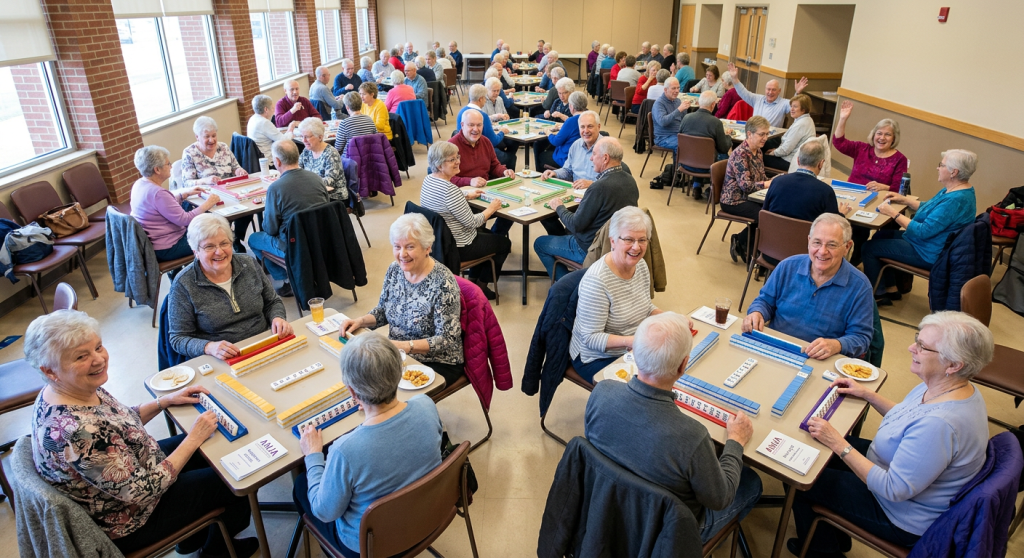
Seniors gathered around tables playing Mahjong game in a community center
A lively group of seniors enjoys playing Mahjong in a bright community room

What is it about mahjong that draws so many people – almost devotees – to the game? I had heard about mahjong several years ago and occasionally thought I would like to discover more. Recently, I’ve come to the conclusion that I want to join the throng. Yet, I know nothing about the rules, the plan, or how to get started.  Thus, I went on a search to find out more.

Mahjong’s current rise is not just nostalgia or novelty — it reflects a broader desire for tactile, social, screens-off activities that combine strategy, tradition, and community. Similar to a card game, mahjong uses tiles that are designed in suits with additional tiles to add dimension to the play. Obviously, the goal is to win a hand, but to get there takes strategically selecting and discarding tiles to yield a set of tiles based on a formula prescribed on a card from the National Mah Jongg League. At least for American Mahjong.

Mahjong has been played in multiple versions including Chinese, Riichi, Hong Kong, Japanese, Taiwanese, and Filipino traditions before coming to America in the 1920s. It is believed there are currently as many as 40 versions. As the communities and rules vary, so do the spellings – mah jong, mah-jongg, and mahjong.

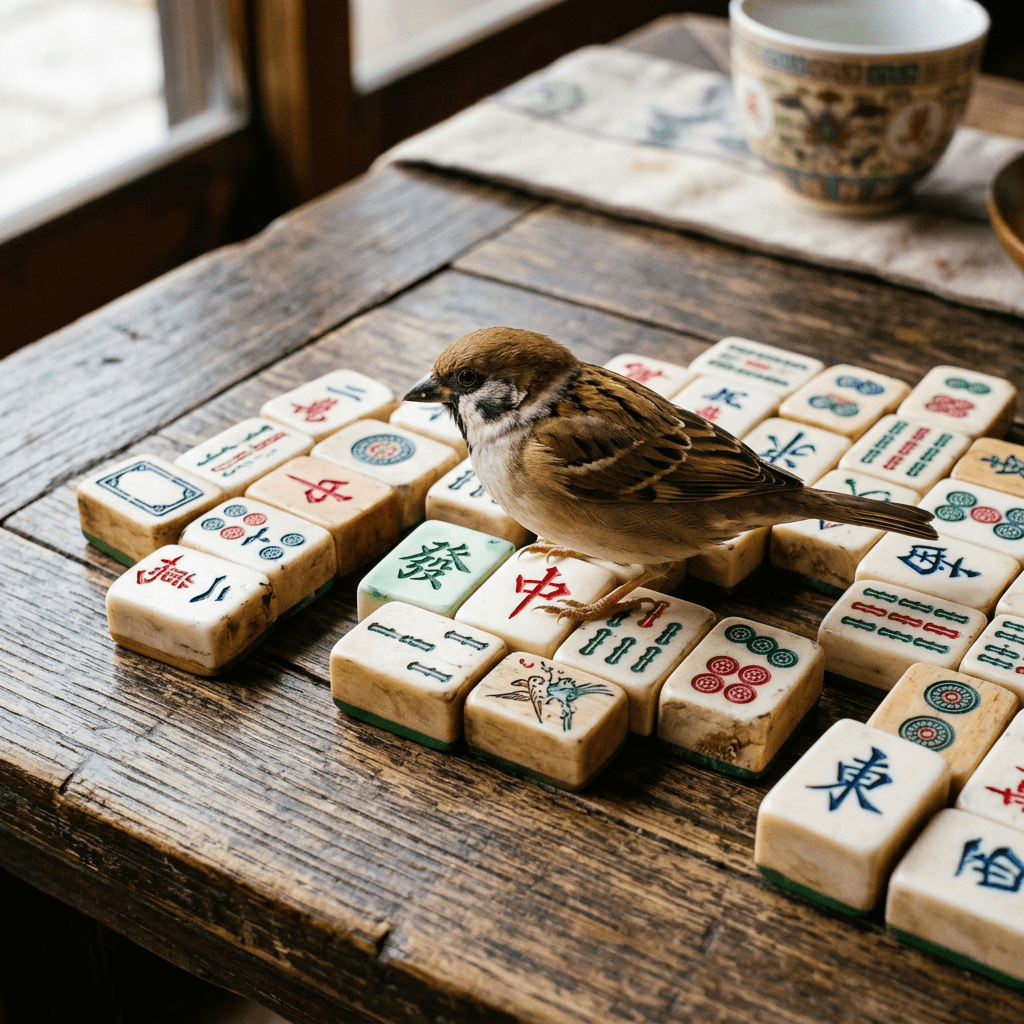
Sparrow standing on mahjong tiles arranged on a rustic wooden table.
A sparrow stands on a set of mahjong tiles on a wooden table near a window.

Mahjong derives its name from Chinese words translated as sparrow, due to the clicking sound made when playing with the tiles. It is easy to understand once you walk into a mahjong house – or Mahj House, as many are called.

Admittedly, as a novice I am intimidated. Yet I see so many people jumping on the bandwagon that I would be remiss if I didn’t join the parade. I have found a few friends who also want to learn. We are signing up for a Mahjong Boot Camp. Yes, there really is such a thing!

For those who want to immerse themselves, there are custom-made tile sets, mats, game-night accessories, jewelry, and more. The mahjong craze does not seem to be a phase.

In our post-pandemic world, people long for face-to-face connection. Playing mahjong allows you to enter a mahj house and join a table, even if you know no one there. Fast friends are made as tiles are passed. It becomes almost an obsession for some people.

Book clubs, Bible study groups, mother’s day out, senior centers, and others are thrilled to have someone teach them to play. I am told that although it seems intimidating at first, once you start playing and the rhythm clicks – pardon the pun – you will be hooked.  I can’t wait! I will let you know how it goes! Meanwhile, you might want to try a group in your own area. You will challenge your brain, have fun, and make new friends.

Le Temps des Cerises

Mary Ann

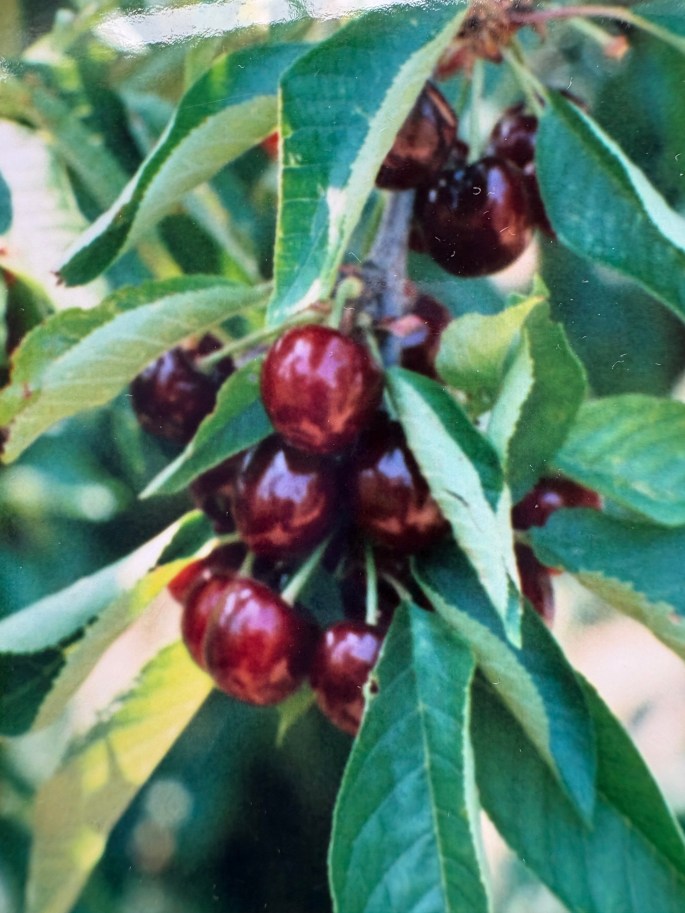
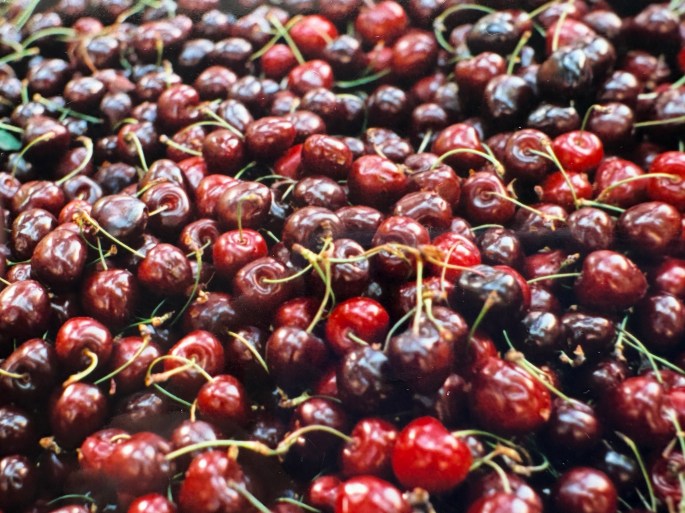
I was travelling in Provence in early August with a group of friends.  We were driving down a country road when we came upon a field of lavender that was surrounded with hedgerows of cherry trees.  You know the kind with big, black, sweet Bing cherries.  They are delicious and as you devour them, they stain your fingers and lips a dark red.  We stopped the car to take pictures of lavender, but I ended up taking pictures of the cherries and tasting one or two.  Scrumptious! It was Le Temps des Cerises – the time of cherries!

I did not know that phrase, but I came across it later in a book.  The time of cherries is a happy time.  Life is good.  It was defined as the time in summer that is carefree and full of love.  Since I was last in France, the phrase has morphed into a clothing line, restaurants, and wine labels.  The phrase reminded me of our American catch phrase,” Life is Just a Bowl of Cherries” capturing that life is going well. (Did you know that phrase came from a 1930 song?) 

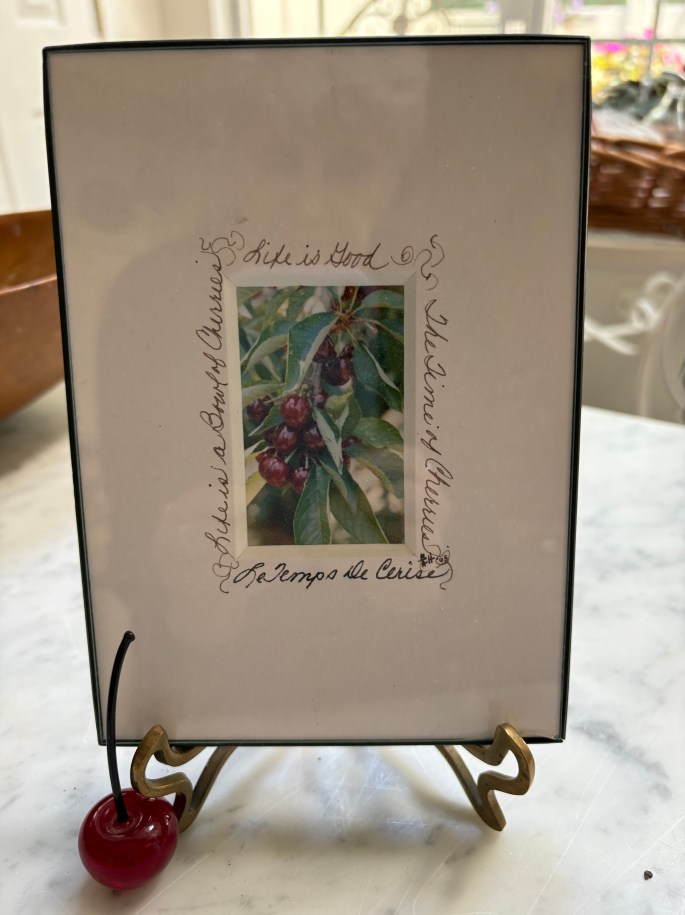
One Christmas, I took the pictures of cherries that I took in Provence and framed them as gifts.  I made a border in fancy script of Le Temps des Cerises, The Time of Cherries, Life is a Bowl of Cherries, and Life is Good that surrounded the picture. I put the photo on a small easel, and I then found glass cherries that I placed near the easel.  A little bit of France with wishes for happiness.  

When I visited Cynthia once, we went to the Oklahoma City Museum of Art to see their glass exhibits.  Dale Chihuly, the Master of Art Glass, has permanent exhibits there.  As a parting gift, Cynthia gave me a glass cherry that I place by my cherry photo.  It is so Cynthia, and the cherry represents the happy time I had with her.  It is always a reminder of her when I look at the cherry photo. 

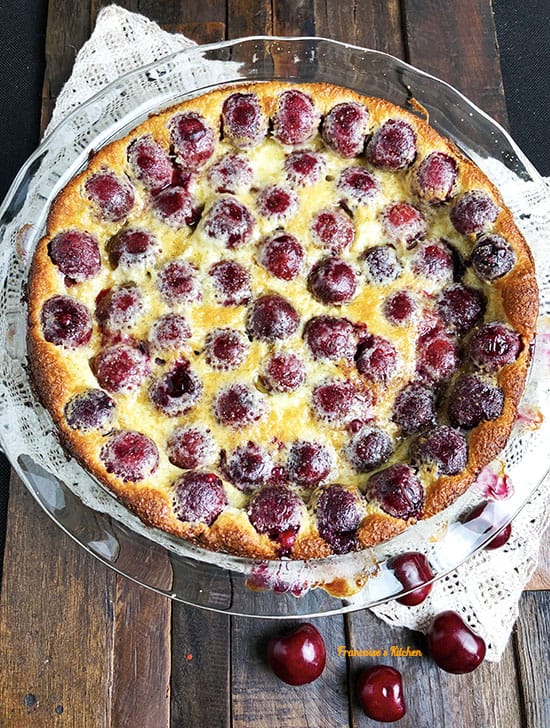
Since we are talking about cherries, let me share with you one of my favorite desserts, and it is French. Clafoutis is a fruit custard dessert that is like a flan with fruits. It is usually made with Bing cherries. Though, I have made it with peaches and pears and is equally as good.  Just use the fruit that is in season. 

Here is the recipe from the Linousin/Augergne (south central) region of France.  I am not sure where I got this recipe so if I have stolen this from Julia Childs, please forgive me.  I have seen several Clafoutis recipes online, so I am not sure any recipe is scared anymore.  

CLAFOUTIS

1 ½ lbs. ripe black (Bing) cherries, not pitted (warn guests about the pits)

2 eggs

1 egg yolk

½ cup (4 oz.) sugar

2 ½ oz. butter, melted

2/3 cup of all-purpose flour

1 cup of milk 

Vanilla sugar (vanilla bean in regular sugar) or 1 teaspoon of vanilla

Preheat oven to 400 degrees; wash, dry, stem the cherries 

Butter an oven proof dish large enough to hold the cherries in a single layer.  Place cherries in dish.  Combine the eggs and the yolk in a bowl, add sugar, and whisk until the mixture is pale in color.  Whisk in the butter.  Sift in the flour and mix well, then add in the milk.  Pour the mixture over the cherries. 

Bake for 40 minutes @ 400 degrees or you could bake @ 350 degrees for 50 minutes until golden brown and a knife comes out clean. 

Your house will smell delicious as the Clafoutis bakes.  It is really an easy recipe and so French.  You will have your very own Les Temps des Cerises, a happy time with friends and family as you enjoy the Clafoutis together.  Bonne Appetite!  Joie De Vivre!

Why Book Clubs?

Book clubs seem to be at every turn. Celebrities and large organizations are getting into the act of hosting book clubs. Many of the popular publications produce lists of must-reads.  Is it any wonder people are gravitating towards book clubs?

In my professional days I had little time to read random genres or books simply for pleasure. As a university executive, I read books on leadership, universities, government, and technical and legal publications. The reading was interesting but rarely light and fun. So, once I retired, I was free to start reading for enjoyment. The question was, “where do I start?” Honestly, I didn’t know what kind of books I would like to read at this juncture.

Hence, I started a book club! Of course I had ulterior motives, too. I needed some intellectual stimulation and a chance to foster friendships. A book club seemed to fit the bill. There are articles, blogs, and websites galore about managing or participating in book clubs. Many are what I would call theme based. Mary Ann for instance has a nature-oriented book club. (She has written about her club previously.) I invited friends whom I believed would enjoy the camaraderie and whom I thought would actually read and discuss the selection.

Group of six people discussing books around a wooden table in a café.

Setting expectations was my first mistake. At first, everyone came and most read the book of the month – or at least some of it. Over time, however, people became less reliable.  In fact, one of the first to drop out, after having little commitment in the first place, started her own book club a couple of years later. That fizzled out too. But that is a different story.

I joined another book club. It is small but members are committed to the process and to each other. It’s wonderful to see the value in coming together for a common purpose. The thing I enjoy most is the variety of genres we read. This particular book club is not theme-based. We have read fiction and non-fiction; Pulitzer Prize and Nobel Prize winning books and beach reads; best sellers and barely known; and well-known and debut authors. Some books are short, some are easy, some are thick, and some are more challenging.

Reading a variety of titles and authors is expanding my thinking and knowledge. How fun it is to seek out the “next read.” The Literary Lattes work well together. The club is self-managing – no one person is in charge – we all share the load, so to speak. What a great group of women and man (yes, only one man in our group!) Since we determine what we will read at least six months in advance, I can have the book on hand.

The Literary Lattes meet at a Barnes and Noble café one morning a month to catch up. Then we discuss the selection of the month. There is no pressure to host (meaning we don’t have to worry about cleaning the house, putting out hors d’oeuvres, or sending someone out after having had too much wine!) Our selections come from some of the recommended reading lists, or from recommendations of friends and family.

I enjoy most of the books but occasionally I don’t care for one of the reads. Still, I am usually glad I read the book. A lesson is to be learned in every experience and books are no exception. I am grateful for the opportunity to read and to discuss with others.  It’s a Reading Rainbow!

Why do I Write?

A couple of weeks ago I mentioned that Mary Ann sent me a book written by her friend Mark McNease. The book, Blank Page to Bookshelf, is about writing fiction, developing characters, and self-publishing. I fall naturally into the self-publishing space. Several years have passed since I attended a weekend writers’ workshop sponsored by a publishing house. I enjoyed the weekend learning about others’ projects and hearing well-known authors talk about their craft. Yet, the thing that most stuck with me was when the head of the publishing house said – and I paraphrase here – there are so many people who want to write a book that it is virtually impossible to get the attention of an editor. One’s best bet is to self-publish.

Once you have sold 100,000 copies, the publishing houses are more likely to pick you up. The interesting thing about that concept is this: if I can sell 100,000 copies myself, why would I then give my publication to an organization who is now going to take 60% or more of my sales? That set the stage for me … and I self-published two books which I then used at workshops. Now all these years later, self-publishing is quite acceptable.

Woman writing in a journal at a desk with computer and books

Although I work more in the non-fiction space, McNease’s book sparked some thoughts for me to ponder. One such question he posed is “why do you write?”  Honestly, I had never thought about why I write.  I just do.  I sit at my keyboard, and words trickle out through my fingers and onto the screen. Is it important to know why I write? I don’t know.

When I was approaching my 30th birthday an astrologer told me I was a writer. This skill somehow showed up in several houses on my birth chart. (Is that even a thing?) I found the idea fascinating as I never had considered the possibility. Yet for some unknown reason I have always remembered Brenda telling me so. I had barely begun my career in higher education, having earned my first doctorate not long before. At the time my biggest concern was that I must “publish or perish” as they say in the industry.

I recall struggling to put words on the page – not because I had nothing to say, but I wasn’t certain I knew how to say things eloquently enough. Still, when I would reread articles, reports, research papers, and monographs months after completing the writings, I thought they were not half bad – some even pretty good. *smile*  And that has held true throughout my career.

When Mary Ann suggested (for three years before we finally got down to business) that we start publishing a blog, I figured it would be easy to write. The hard part, in all honesty, was setting up the site, learning the platform, and developing a schedule. The two of us over-planned, until finally we said, “it doesn’t have to be perfect.” We will learn as we go. When we were able to let go of perfection, we could do what we enjoyed. Write.

So why do I write?  I guess I just find it relaxing to record my thoughts. Not everyone enjoys writing but we all have outlets. What do you do that releases your creative juices?

Blowing in the Wind

Remember the Peter, Paul, and Mary song “Blowin’ in the Wind”? Well, I don’t know if the answer is blowing in the wind, but I do know there is a lovely way to know the wind is coming through.

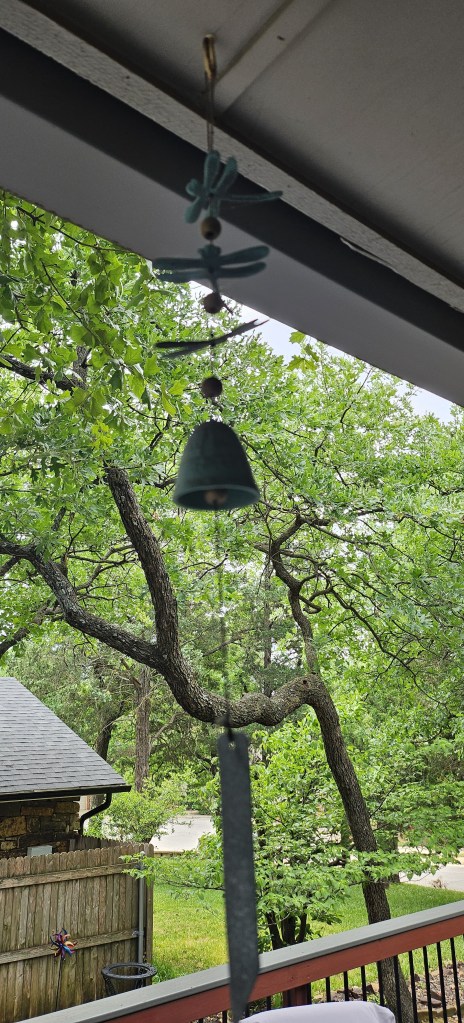
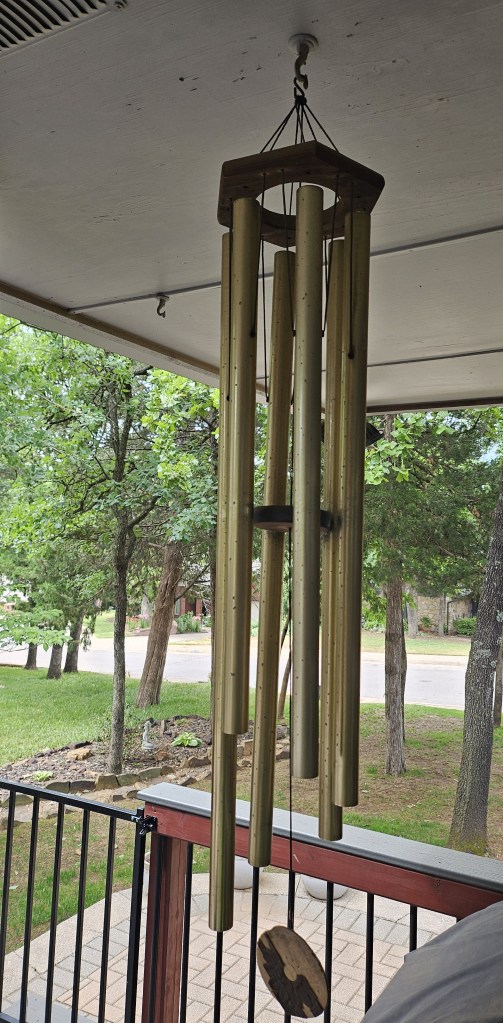
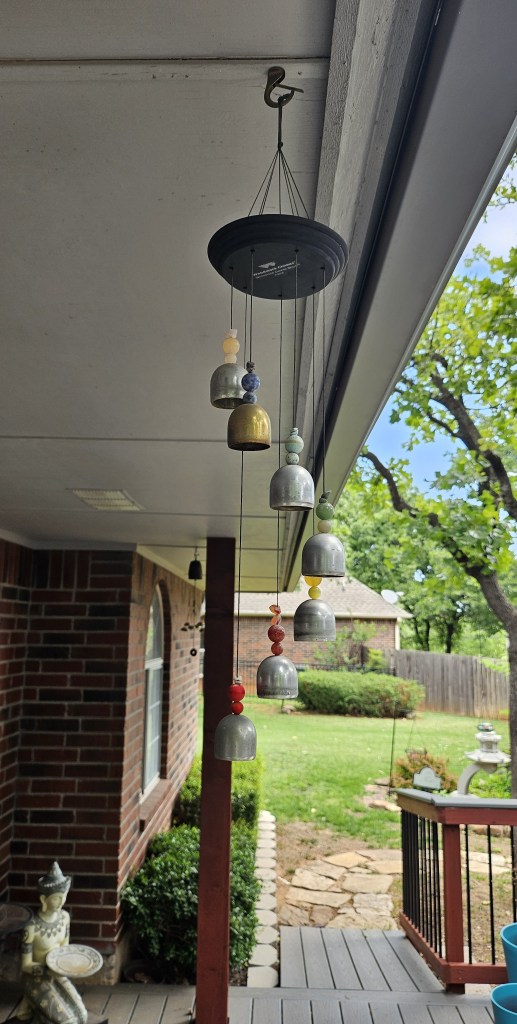
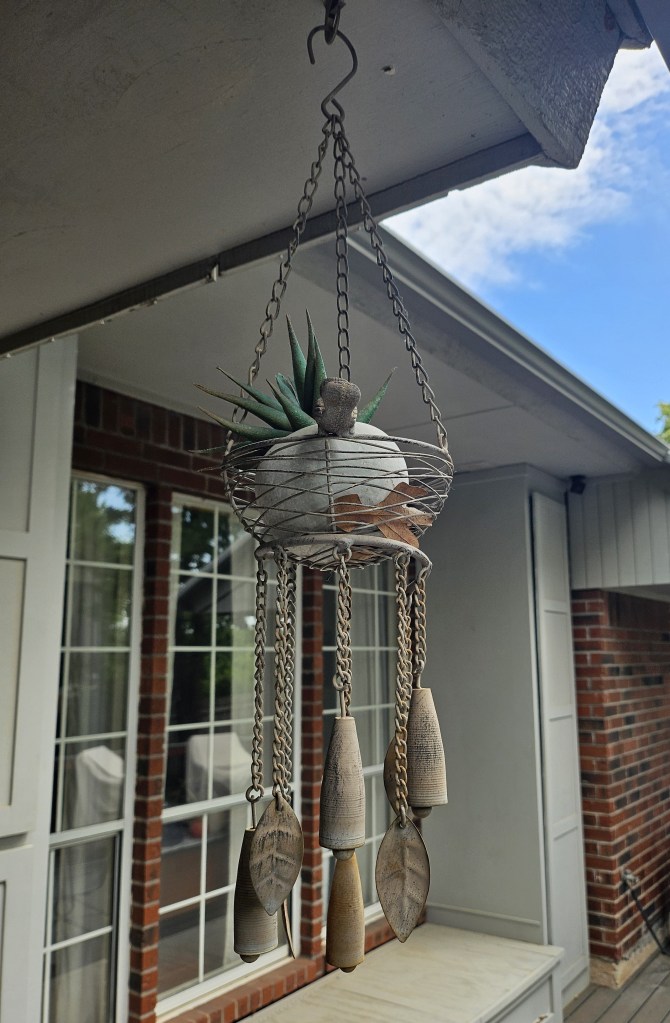
I can’t remember when I first fell in love with the sound of wind chimes but for as long as I can remember I have enjoyed hearing the melodious … and sometimes tinkling … sounds as the breeze hits the paddles on the chimes. The wind finds its way through the hanging structures and tickles the components designed to strike one another.  Today as I sit with nothing particular to do or place to be, I can enjoy the music of the many wind chimes hung along my deck.

Usually, I just subtly enjoy the sounds emanating from the chimes but today I am focused on the joy of these little additions to my urban oasis. Often, I have wondered how the neighbors react to my chimes. My deck faces the side of one neighbor’s home and the gentleman who lives there is the nicest of people. He recently married. I was delighted when his beautiful wife added a chime to their front yard, joining mine in chorus.

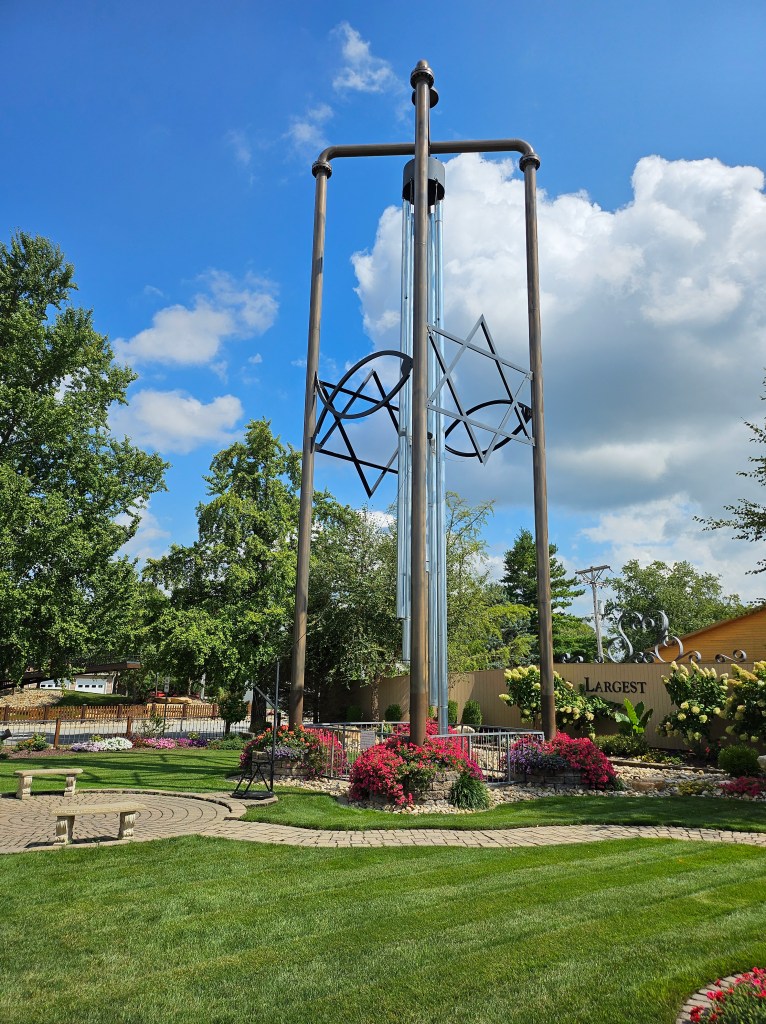
I am reminded of a fun city – Casey, Illinois – where their tag line is “Big Things, Small Town.” Jim Bolin owned a pipeline business. On a family vacation his daughter fell in love with a tea shop in Colorado and asked her parents if they could start a tea shop in their small town. Jim felt they needed a way to draw people off the interstate to their tea shop. One day when he was listening to his wind chime, he wondered “what is the world’s largest wind chime?” Using pipes from his business it took two years to create just that. And the town caught on. This little town is full of “world’s largest” items. While some of their items may not be the world’s largest, all are still amazingly huge. The town is creative, innovative, and just plain fun. They love their visitors who stay, shop, and eat there … and who of course, take lots of pictures!  I even bought a couple of wind chimes at the tea shop to take home as gifts along with the story of the town.

When selecting wind chimes, I admit I am a bit picky. Okay. I am very picky. I want chimes that have a lovely, tonal quality.  Some chimes are pretty, festive, or cute but they have that shrill tinny sound that is more distracting than calming. Wind chimes don’t have to be large to produce soothing sounds. In fact, some of my lovely chimes are so heavy they only ring when the wind is blowing really hard. Those I enjoy just watching them sway while the others take on the responsibility of creating music.

Do you have a wind chime? Next time you have your door open or sit outside, take time to allow yourself to be enveloped by the sounds emanating from your chime. And then smile as you remember this is one way nature calls to you.

Honk Honk from the Porch

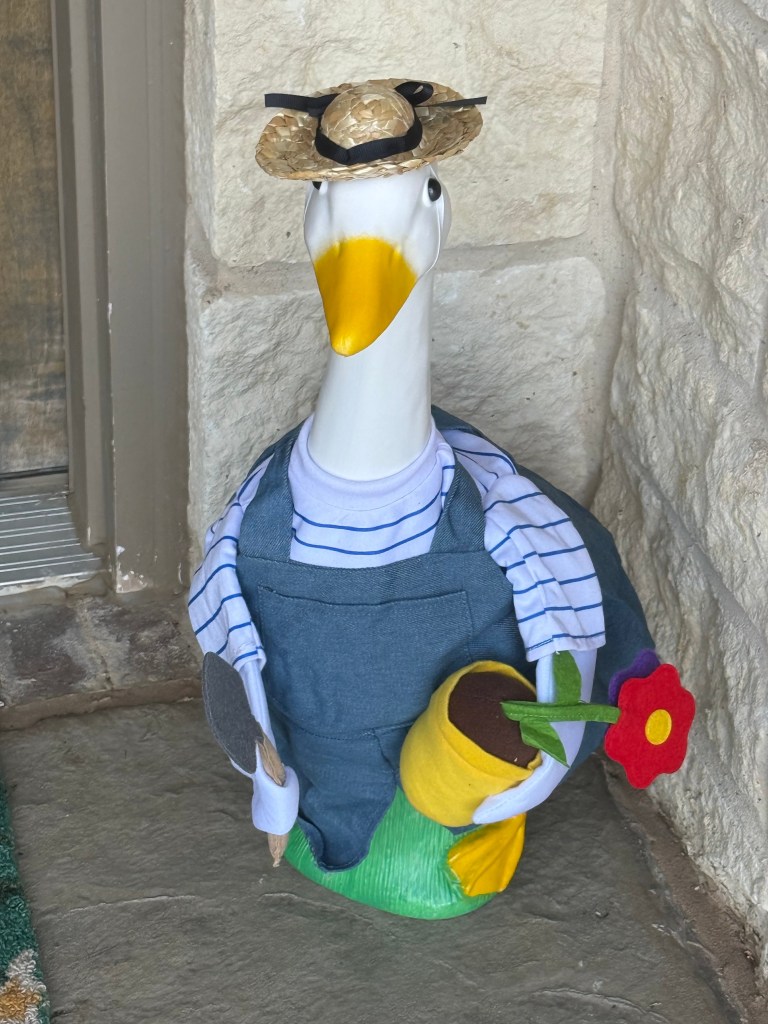
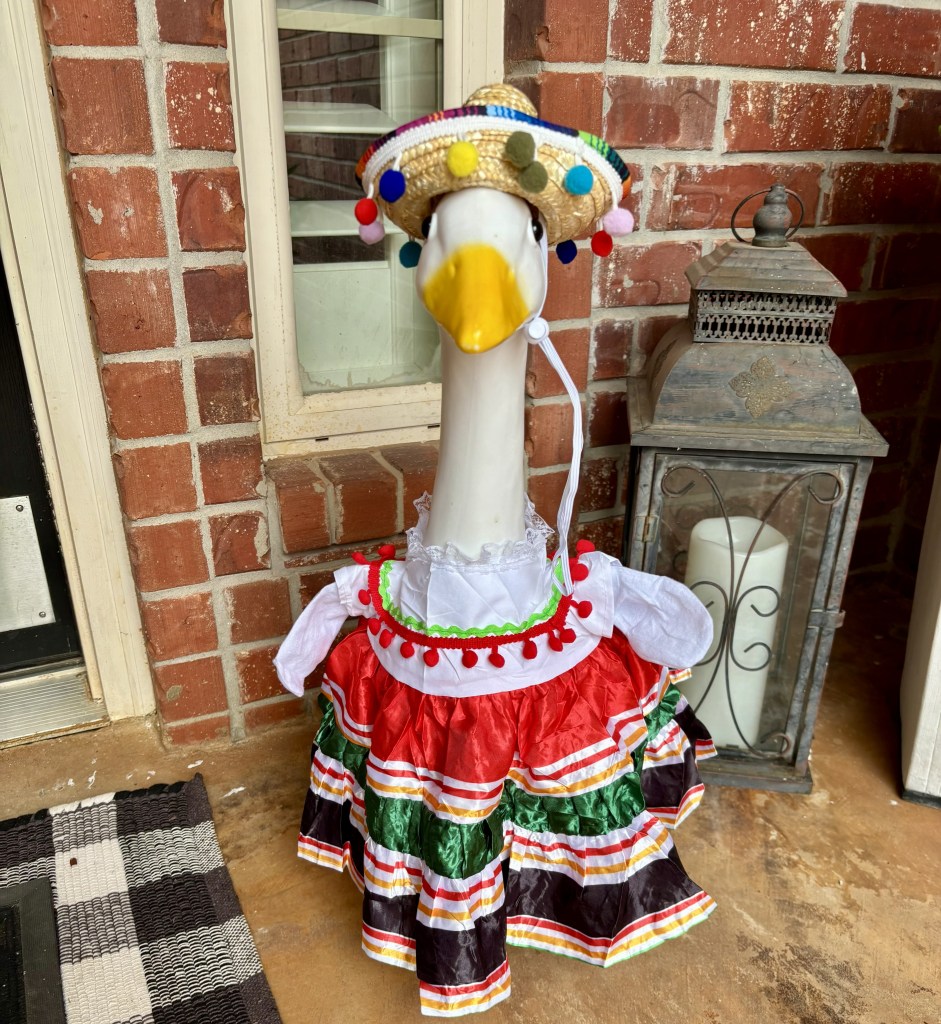
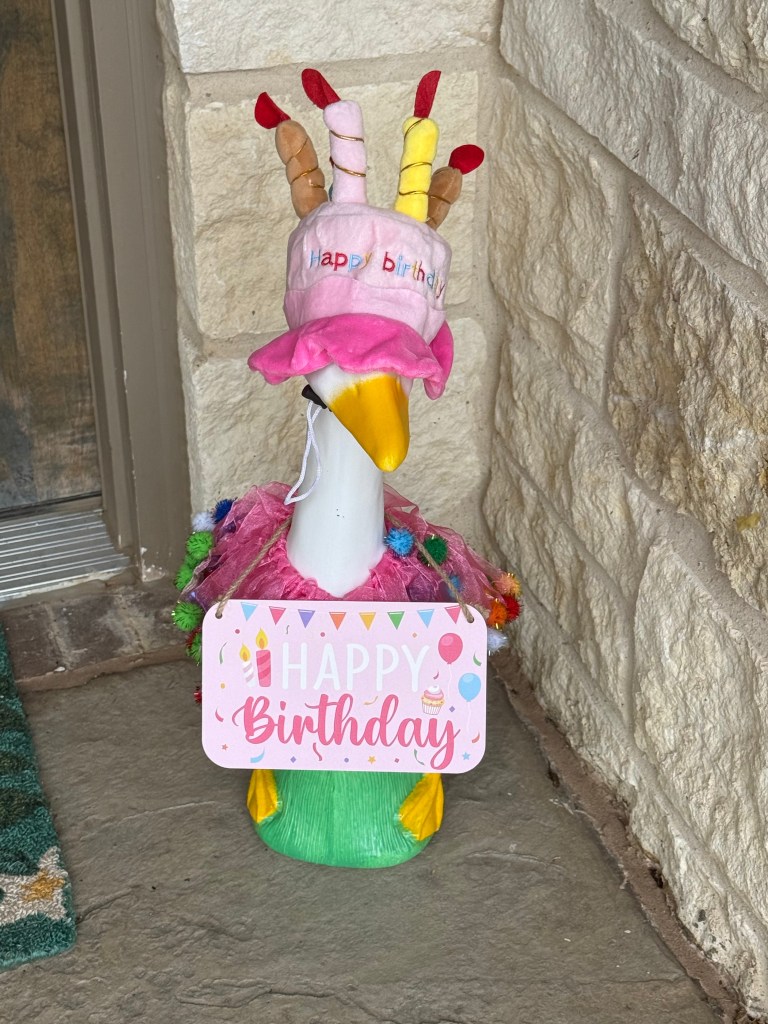
The idea of porch geese became an outdoor décor frenzy during the 1980s. Recently they have made a comeback. The fascinating thing is that it’s not just us old timers! TikTok and Instagram videos have gone viral, attracting Millennials and Gen Z-ers to the “sport” of displaying their goose in relevant holiday style. Yes, minimalism is out, at least when it comes to one’s porch goose. What makes them fun and unique is they are adorned with a variety of outfits.  It reminds me of playing Barbie when I inherited my great-grandmother’s hatbox which became my Barbie clothes and accessories suitcase.

Porch geese can be created from any number of materials: concrete, ceramic, and plastic are the most common. These “dolls” are not cheap. Concrete ones cost around $150.00.

There are even Porch Geese clubs! One such club is The Porch Goose Club of America which offers “holiday contests, laughs, and most of all a safe place to be silly with friends from all around the world.” There is a Facebook group for Porch geese aficionados. These people are serious collectors – in a fun and light-hearted manner!

To be honest, I don’t remember porch geese or the garden goose as a trend in the 1980s. Of course, I was finishing graduate school and building my career while rearing my daughter as a single parent. Having a porch goose would have been unnecessary even if I had known about them. I do remember my sister having Gooseberry cookbooks. I wonder if those were popular because of porch geese.

Recently I learned about the porch goose craze because my 84-year aunt, whom I adore and hang out with frequently, had one on her porch. It was dressed to the nines! The goose and several outfits had been given to her by her granddaughter. Lucy (Goosey), as she calls the little darling changes clothes frequently. She was so much fun, I decided to get one for my sister for her birthday.

Lisa loves to decorate for every holiday imaginable (not sure where she gets that – ahem) and she lives somewhat in the country, so I knew she would enjoy a fun little addition to her front porch. Her goose is Flo(rence). I sent Flo to her along with outfits for gardening, birthday, and Independence Day.

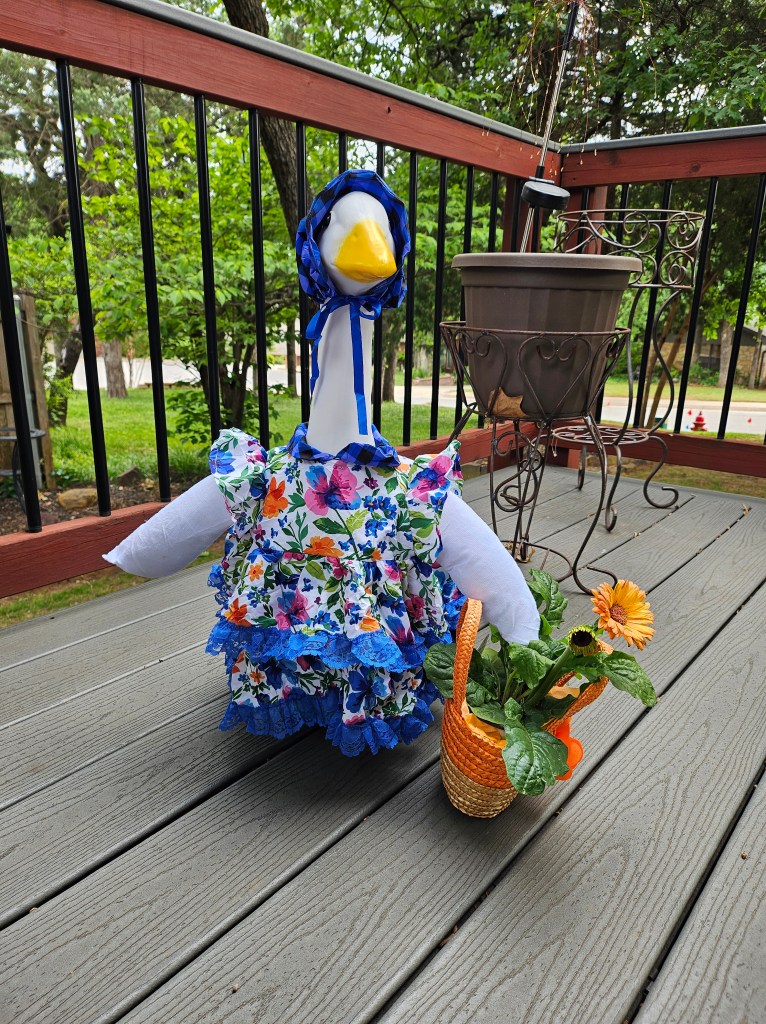
On May Day I usually give flowers or plants to people, but I failed to plan ahead this year. I went out to lunch and when I returned home, I noticed something flowery was on my deck. I assumed it was my aunt (rightly so) who left me a plant. But when I went to the deck, I found Daisy Ganderella in a ruffled dress, holding a small straw basket that contained a fresh Gerbera daisy (hence her name, you see).  So, I have officially joined the porch goose craze.

I can’t help but smile when I see Daisy G. on the deck. I wonder what the squirrels think of her.

Nature Book Club 

Mary Ann

Every three or four books that I read; I usually select a nature book.  I love nature.  That love comes from my father who was a biology teacher.  It was a gift that he gave to my brother and me.  We were full of curiosity as children, and our father would cheer us on with stories and interesting facts about a butterfly or a fish or whatever we would find.    

People who love nature are born that way.  Harvard professor Howard Gardner’s Theory on Multiple Intelligence determined humans have a propensity to have one or more of basic intelligences or Smarts that include Word, Picture, Body, Music, People, Self, Logic and Nature.  People who are Nature Smart enjoy rocks, plants, and animals; hear and see links in nature; and like to spend time outdoors.  That was my father, my brother, and me – we were all Nature Smart!

Many of my neighbors and friends are also Nature Smart.  We call each other when we spot a fox or see a Monarch Butterfly in our yards. I have written about this in other blogs.  I guess it was only natural that birds of a feather would flock together, and inevitably we would decide to start a nature book club so we could talk about the things we love.

So, a few of us met a year ago in August to set up the perimeters of the club and determine the books that we were going to read.  There were five of us to start, and we slowly added three more people.  I looked online for information on how to start a club and things to consider.  Cynthia was very helpful in sharing her experiences with book clubs.  She has been a member of several over the years. 

At first, we tried to meet at a nature center, and then we tried bookstores.  There were several restrictions at those locations, and you could not have refreshments – NO wine!  The venue then changed to our neighborhood homes.  We decided to meet the last Wednesday of the month from 7 to 9 pm.  Members would host meetings providing space, refreshments, and questions for the monthly book selection. There are many Internet resources to find questions so that really is not hard to do.   We would meet September through November with December off for the holidays, and regroup in January with meetings in February, March, April, and May.   June and July would be off for vacations and summer fun, and we would meet again in August to select books for the coming year.  The August meeting would be a covered dish or a dinner at a local restaurant.

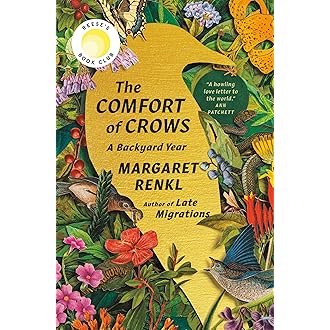
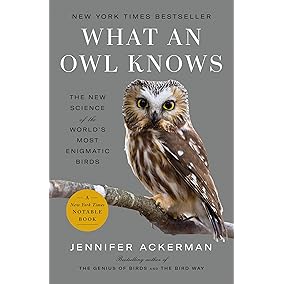
The book selections were relatively easy.  We were open to all possibilities.  Everyone wanted to read Amy Tan’s Backyard Bird Chronicles so that was our first book selection.  We followed with Voices in the Ocean by Susan Casey about dolphins.  There were a few challenging parts that were not for the faint of heart.  Life is hard for dolphins – it was not a Flipper adventure.  In November we read The Secret Life of Nature by Peter Wohlleben who has written several books about trees.  Fun Fact – trees know their own baby trees.  There is a lot going on in the ground under a tree.   We started again in January with The Comfort of Crows by Margaret Renkl that followed the author’s observation of plants and animals in her backyard.  We then read Nature’s Best Hope: A New Approach to Conservations that Starts in Your Own Yard by Douglas W. Tallamy that gives several suggests helping humans harmoniously live with nature.  The March reading was Eager by Ben Goldfarb about beavers.  They are furry little heroes for the environment.  What an Owl Knows by Jennifer Ackerman followed in April, and it was a fascinating book about these mysterious birds.  World of Wonders by Aimee Nezhukumatathil.  (Poor Aimee had to learn to spell that long name when she started school – oh, my!).  This Barnes and Noble book of the year is a collection of essays about interesting plant and animal facts – whale sharks, fireflies or narwhals!  And so, our first-year ends.

With all book clubs, there is a very big social element to them. Conversations can be all over the place.  We hysterically laughed one evening after reading Nature’s Best Hope.  We have a very strict HOA where most of us live, and they probably would object to us planting certain things to sustain the environment.  We decided to organize a group of guerrilla gardeners, and in the dead of night we would gather to plant milkweed throughout the complex to support monarch migration. However, if little patches of milkweed start sprouting up, we know nothing about it….

 Just remember that attendance will not be perfect each month.  People are busy with life. Find your people, those Nature Smart ones, and start your own club.  We have given you an outline how to organize and a list of books to begin.  Enjoy the camaraderie, learn about your environment, and appreciate being green.  You know it is not easy being green! 

New York, New York – Part 5

New York City Shops 

Mary Ann 

Ask anyone in New York, what is the best city in the world?  They will all tell you, New York City, of course!  It may be your favorite city too.  Despite the crowding, dirty streets, foul smells, and the like, it remains a beloved place for people from all over the world.  It is the seat of entertainment, finance, art, and on and on.  Those of us who got the chance to live or work there know how special a city it is.  Yet, below what you first see, there is a bustling city of matchless wonders.

New York City is full of unique people; however, it is equally full of unique shops.  When exploring the city, these charming places make an adventure unfolding around every corner. During my time in New York City, I enjoyed discovering many of the city’s best kept secrets.  We all know Macy’s or Bloomingdales – where tourist roam!  People seldom unearth the treasures of the one-of-a kind shops that populate New York. 

The island of Manhattan has various districts for garments, flowers, furniture, jewelry, diamonds, etc.  Nestled in among the warehouses, you can often find shops that sell wholesale items to the public.  I can remember once going into a costume jewelry store, and I thought I had gone to earring heaven. Row upon row of very pretty, very inexpensive earrings greeted me as I entered.  

In this blog, I want to share with you some of the distinctive places I found, and the best place to start is with sweets.  Birthdays at my school were always a little over the top with treats for fellow classmates and teachers.  As principal, I was included as well – lucky me!  There were delicious cupcakes and whoopie pies and giant cookies.  Some of the best treats came from world-famous Magnolia’s on Bleeker Street. The cupcakes were exceptional; however, the banana pudding is out-of-this-world.  Magnolia does ship their baked goods, but the banana pudding recipe can be found online.  I have made it, and the pudding is very close to the original.  Another favorite of mine is Baked by Melissa.  This bakery has a few shops throughout the city. The cupcakes are quarter-sized morsels of pure delight.  They have hundreds of flavors that they change in and out.  You can stop by and pick up a few to nibble as you walk down the street.   Melissa also ships their mini cupcakes all over, and they offer lovely holiday assortments.  They have a cute 3-pack that are nice to give as memorable favors. 

Occasionally, a new yummy would hit the market. When the summer of cronuts premiered in the city, the lines wound around the block. They were a combo of a donut and a croissant and were coveted.   You were crestfallen when you finally got to the front of the line only to find out they were out. Tears prevailed and sometimes colorful screaming!   

Then we have the candy shops.  Time Square has its Hersey and Reese’s shops, but they do not compare to the riches of the specialty chocolate shops that pepper the city.   Jacques Torres is probably one of the most famous.  The chocolate is good, and they will add red peppers or some other exotic ingredient to the chocolate to give it a tasty little kick.  The chocolate comes in all shapes and sizes.  I do love their very rich hot chocolate that comes in a variety of flavors – great on a cold NYC day.  My favorite chocolate shop is Li-Lac’s, the oldest chocolate house in Manhattan founded in 1923 – there are several locations.  It has the creamiest chocolate – once you start eating it, you can’t stop. They ship as well. 

 Another favorite candy store was Sockerbit featuring gummies, licorice, and chocolates.  It was a stop and mix store, so you paid by weight of your mixed bag.  Unfortunately, it closed, but Bon Bon and Lil Sweet Treat have opened in the West Village offering the same candies. What I noticed as I was checking out the shops, the locations may have changed or there is a new name for the same products. I think Covid changed the market in many cases.

One-item shops prospers in New York City.  It would be hard for such shops to make it somewhere else.  It take several million people to make it happen.  However, it makes the shops memorable due to their uniqueness.  There is a rice pudding store, Rice to Riches, where a variety of favors and toppings are offered.  I found a shop that only sells salt with some chocolates, flowers and bitters called Meadows.   The Parisian Laduree has a shop in NYC with their famous macrons – there are other macron only shops as well.  How about a shop that only sells tassels and trims?  Or a shop that sells mostly trays.  Then there is a shop that sells just belts.  The possibilities are almost endless.  There is a lot of turnovers, yet some old timers remain. 

There are bookstores that only sell one type of book – cookbooks, mysteries, or children’s books.  Wonderful selections to explore. Barnes and Noble bookstore has several stores with huge inventories. New Yorkers are readers.  The best of all is The Strand – a landmark bookstore near Union Square.  All kinds of books, old and new, are available.    It is a fun place to while away a few hours.

I could go on and on. Yet, I haven’t even talked about the restaurants or the many exclusive services.  I will save that for the next New York, New York blog, and we can visit them together. 

Happy Easter

Growing up, my family attended a Disciples of Christ, First Christian Church. As with many Christian churches, the Holy Week was a time of deep reflection and spiritual renewal – fitting as the religious holiday falls on the first Sunday after the first full moon after the vernal (Spring) equinox, i.e. first day of Spring. This determination was established by the Council of Nicaea in 325 AD. The date of Easter fluctuates but will fall on a Sunday between March 22 and April 25.

The formula was designed so that Easter usually falls after the holiday of Passover.  The Lenten season begins with Ash Wednesday which is calculated by counting back 46 days from Easter, allowing for the traditional 40 days of fasting and six Sundays. Interestingly, the word Easter appears only in one verse in Acts in the King James version of the New Testament and is considered by Biblical scholars as a mistranslation of the Hebrew word for Passover. Early Christians celebrated Jewish holidays, albeit with a new determination.

Still, Easter has come to be a remembrance of the birth and resurrection of Jesus Christ. Some argue that the name Easter is derived from the pagan celebration of the goddess of rebirth, Eostre, around the spring equinox. Our use of eggs and bunnies reflect this theme of spring and birth. Regardless of its origins, Christians have for centuries adopted Easter as a significant milestone in their spiritual calendar.

Although my religious upbringing did not emphasize Lent as do other traditions, we did spend a lot of time at church during Holy Week, beginning with Palm Sunday. I recall the children marching down the aisles waving palm branches and singing hosanna. Even today, the memory stirs something deep in my soul. It brings to life the difference a week can make – from the throngs following Jesus and cheering to the brutal assassination five days later.

I recall how various church members faithfully prayed around the clock, each person taking their turn to keep prayer going from the Maundy Thursday service through Good Friday, sunrise services, and the “official” Easter morning service.  It was a time of “coming together” for the greater good.

These memories seem to be flooding my mind this year.  Maybe because of one of my 2026 goals – to read the entire Bible in a year. Yes, I have read the Bible before, but I’ve never made a concerted effort to read it within a year’s timeframe. Maybe it is because as I grow older and my family is off living their own lives, I am calling upon other forms of solace. Maybe I am looking for a level of calm and integrity. Maybe it is simply a full circle moment.  Regardless, I wish for you a lovely spring, peace, and deviled eggs and chocolate bunnies.

Author’s Note: While I share my religious memories here, please know that this reflection is just that – thoughts of my study and my upbringing. I have studied several other religions and respect both the teachings of each and the individual’s choice to follow another … or none at all.

Museums

Mary Ann

From the beginning of civilizations, humans have been hoarders or to say in a kinder way, packrats.  Luckily, it has been a blessing, and we have museums all over the world to prove it.  The Pharaohs took everything with them for the afterlife.  Instead, it has given us today a view of what life was like for the select few in ancient times.  Thank you, King Tut!

We all know the big museums like the Smithsonian museums, The Metropolitan or Nature History Museum in NYC, The British Museum in London, or the Louvre in Paris.  We all want to see the Mona Lisa at the Louvre – surprise, it was kind of small.  I walked by the Rosetta Stone at the British Museum several times until I asked a guard where it was.  It was also small.  How could several languages be on such a small slab of stone?  I thought it should be the size of a wall with such information.  Wrong again.  Then there are the dinosaur exhibits which are so prevalent at the world’s museums.  I have always loved seeing dinosaurs.  I think that most people do.  The dinosaur halls are always jammed and not only with children. 

One of the gifts of travel is the chance to see museums that are around the world, and those museums connect us to each other and our common humanity.  I remember years ago going to the Hellenic National Archaeological Museum in Athens, Greece.  They had a newly opened Children’s Museum. It was about children rather than for children.  It was fascinating to see how much in common today’s children had with children from 4000 years ago.  They had potty chairs and sippy cups.  The children played with small animals and balls that were captured in sculptures of the time.  Children remain the same.  A good lesson for us all – basically, we haven’t changed much.  

Museums can move you emotionally in both sad and joyous ways.  Anne Frank’s House in Amsterdam is an example.  I was surprised to find how big the attic space was.  As I read Anne’s diary, I had pictured the families in just a couple tiny rooms.  They were more spacious than imagined, but it was still confining to live silently for years.  You can only feel that by standing in the exact rooms.  Visiting Auschwitz in Poland, there is a solemn atmosphere surrounding the camp.  Walking into the showers and seeing the ovens stays with you.  How could humans treat other humans in such brutal ways?  Museums help us to remember.

As sad as some of the museums are, there are many more that brings great joy!  What could be better than looking at Monet waterlilies in the L’Orangeries in Tuileries Gardens in Paris.  Giant waterlilies!  It is breathtaking!  The Musee Marmottan Monet is on a quiet street in Paris, and it houses the largest collection of Monets in the world.  It is not a busy museum so you can take your time sitting and soaking in the masterpieces. By now you know that I love Monet.  Throughout the world, there are many museums that focus on the work of one artist.  You learn so much visiting each one, and you will be ready for the next game of Jeopardy!

Then there are outdoor museums like the ones in Scandinavia where you can see anything from a baby moose to handicrafts and replicas of ancient dwellings.  You get to walk around outside learning about the various cultures. There are sculpture gardens, and as you walk on winding paths through the woods, you see great works of art nestled into the landscape.  I have been to Millesgarden in Sweden and Grounds for Sculpture in New Jersey.  All fun!

However, my favorite museums are the quirky ones throughout the world. I am always looking for them when traveling.  In England there was a dog collar museum in Leeds, England – the kind that a big Mastiff might wear with pointed metal “teeth”.   A favorite was the Mummified Crocodile Museum in Egypt (featured below).  The Egyptians mummified crocodiles to honor the god Sobek.  The pharaohs took everything with them and maybe even the kitchen sink.  I guess they thought they would need crocodiles in the afterlife??  Drum roll!!! The most unique museum I ever found was The Icelandic Phallological Museum in Reykjavik.  Yes, a penis museum! It is like you have finally seen everything.  So, I am wishing you some great discoveries as you visit museums around the world. You never know what you might find along the way.  Maybe even a Pharaoh’s kitchen sink?