Fresh Start

Driving down the street today I noticed a neighbor had several items sitting on the ground next to his garbage bins. I smiled to myself. Ah.  It’s the new year and people are thinking about cleaning up and weeding out items that are no longer of value.  I do that year around, although as I am putting away holiday décor, I have started a box of give-away items. And I am filling my garbage can with things no longer useful.

One of my goals for 2026 is to read 24 books. Some of you are thinking, “big deal” and others are thinking “that many!” Underlying this goal is a different motivation.  I have too many books in shelves – not only in my office but on shelves throughout my home. Some have never been read; others are waiting for a second or third reading. Regardless, it is time to begin honing the collection to those tomes that are especially important to me.

Cookbooks are my friends. For Christmas I displayed four Christmas-inspired cookbooks. When I went to put them away, the cookbook shelves had expanded into another bookcase. I needed to make room.  In doing so, I came across some old “Who’s Who” publications. Some of these have moved around the country with me and sat on bookshelves since the 1980s!  It was definitely time to part with these encyclopedias of peoples’ identities and accomplishments.

Of course I had to take one last look at my entry before tossing the [very heavy] books into the recycling bin. Imagine my dismay when I read my full name (including my maiden name), my birthdate and birth location, parents names, children’s names, and places I worked. Immediately I tore out those pages and ran them through the shredder, as if somehow that would hide these personal details.

It is naïve to think that would be the end of it. What have the hundreds or thousands of other people done with my information – and theirs?! The thought trail took me back to that time – a simpler life when we were more trusting; more open with strangers.  When one would think nothing of picking up a hitch-hiker to help them to the next destination. A time when everyone knew their neighbors as they were not hidden away behind camera doorbells and gated communities.  It was a time when we celebrated others’ accomplishments instead of trying to “one-up” them. Ah. The good ol’ days.

Maybe we can start with ourselves and one-by-one expand our private worlds to others – at least by reaching out to neighbors or people at church or the grocery store. A simple smile to a stranger goes a long way and just may instill in them a sense that life is worth living.

I’m glad to be reminded that people are important. Things are not.  I am going to reach out to some acquaintances; then resume the cleaning and organizing to begin a new year fresh and happy.
Junie

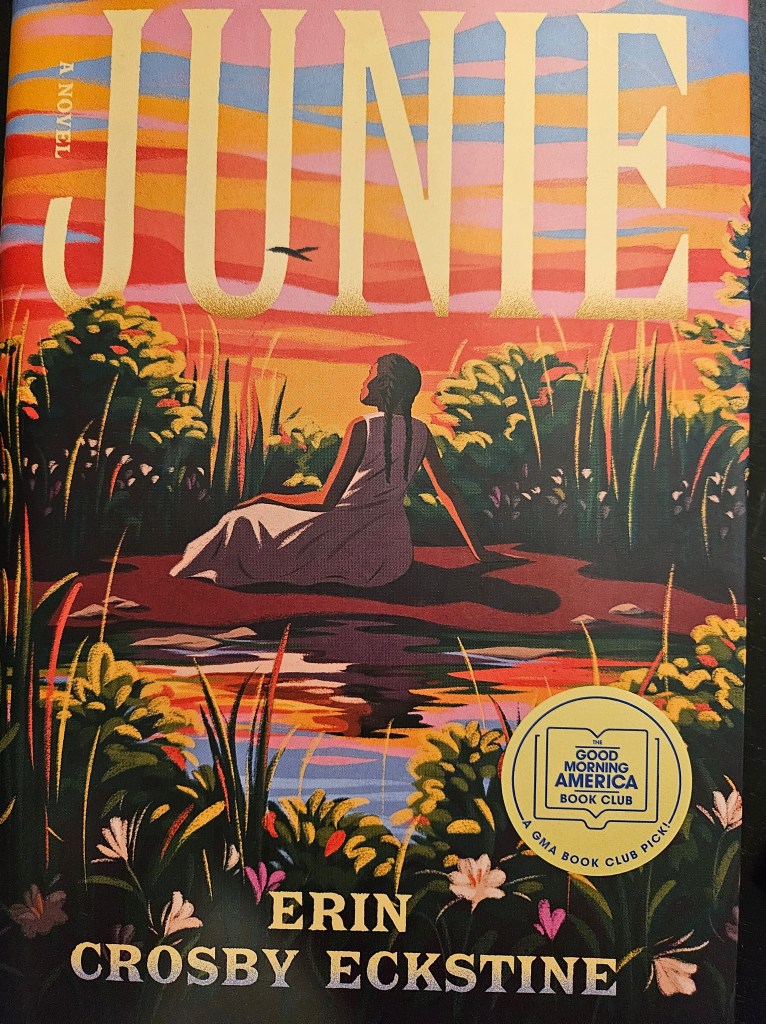
“JUNIE,” by Erin Crosby Eckstine, is a compelling literary work of historical fiction that delves into the complexities of family ties, personal identity, and the enduring spirit of its protagonist. With a narrative that is both heartfelt and evocative, Eckstine creates a world that is at once intimate and universally relatable, drawing readers into the emotional journey of Junie herself.

The story centers around Junie, a young woman navigating the turbulent waters of slavery, adolescence, and early adulthood. Set primarily on a struggling plantation, the novel explores themes of belonging and alienation as Junie grapples with family secrets, shifting relationships, and the challenges of self-discovery. Eckstine masterfully weaves together past and present, allowing readers to uncover layers of Junie’s history and the factors that have shaped her worldview.

Eckstine excels in this novel with her character development. Junie is portrayed with remarkable depth, her vulnerabilities and strengths both realistic and endearing. Supporting characters—family members, friends, and romantic relationships —are equally well-drawn, each contributing to Junie’s growth in meaningful ways. Eckstine’s empathetic approach ensures that even secondary characters feel authentic, their interactions with Junie serving as catalysts for pivotal moments in the narrative.

Eckstine’s prose is lyrical yet accessible, balancing poetic descriptions with straightforward dialogue. Some reviews felt the first of the novel moved too slowly, however, the novel’s pacing allows for reflection, giving readers space to consider the emotional weight of Junie’s experiences. The pacing allows for deeper characterization. Central themes include the search for identity, the importance of forgiveness, and the resilience required to overcome adversity. Eckstine also touches on issues such as generational trauma and the power dynamics within families, offering thoughtful commentary without becoming didactic.

The book excels in its emotional resonance and authenticity. I found myself rooting for Junie, invested in her struggles and triumphs. Eckstine’s ability to evoke empathy is notable, making the narrative both moving and memorable.

Overall, “JUNIE” by Erin Crosby Eckstine stands out as a beautifully rendered exploration of family, identity, and resilience. The novel’s introspective tone, strong character work, and nuanced handling of difficult themes make it a rewarding read for those who appreciate literary historical  fiction with heart and substance. Eckstine’s debut marks her as a promising voice, and “JUNIE” is certain to resonate with readers long after the final page is turned.

Delight in our Elders

Drew, one of the ladies in my book club frequently mentions her father, Van, who also loves to read. Occasionally, we select a book to read based on his recommendation. As with our members, Van enjoys reading from multiple genres. At one meeting we suggested Van may like to visit – or even join – our book club discussion.

What a delight it was this month when Drew and Van walked into our Barnes and Noble coffee shop a few minutes before we began. Van was tall, moved with precision, and sported the kindest expression on his face when I approached them. I couldn’t help myself.  I told him Drew had talked fondly of him and asked if I could hug him. He graciously allowed me to gently embrace him.

We ordered coffee drinks. They selected seating in the corner where it might be a little quieter. At 95, Van has lost some of his ability to hear well. As soon as everyone was seated, Van jumped in to begin discussing Junie, our January selection. He mentioned how much he enjoyed the book. He was impressed that the author, Erin Crosby Eckstine was able to write her first novel with such aplomb. Van commented on a hopeful ending to the story for one of the primary characters, Caleb.

I listened with awe as Van recalled characters’ names, authors and titles of additional books he had read. His memory and recall were sharp and his diction clear. He told us a little about being in Alabama when even the military base was segregated (relating to the story line of our book discussion.) Van was a valued participant in our discussion.

He asked if we were looking for additional members and we responded affirmatively. We invited him to return any time; even to join if he would enjoy conversing with this female-dominated club.

Spending this short time with Van, I am reminded of the value of including our elders. Here in the United States of America we fail to honor our senior citizens. With age one gains wisdom along with experience. There is much to learn and appreciate from others, especially from those who have walked the path before us.

At the same time, we help our older citizens live life more fully. Getting older can be emotionally and socially challenging. Our friends and family may pass before us, leaving us without someone with whom to share time.

Look for Vans in your life. The mutual benefit will bring happiness to you both.

Five Types of Wealth: Social

Wealth, as a concept, is often narrowly construed as a matter of finances—a sum of assets, investments, and monetary resources. However, true prosperity is multidimensional. Over the years, scholars, thought leaders, and personal development experts have increasingly recognized that wealth comes in various forms. Sahil Bloom (whom we have previously reviewed) looks at wealth in terms of time, mental, physical, financial and social.

Social Wealth, so to speak, relates to one of my goals for 2026. I aim to make at least one new friend this year.  An article on relationships I recently read indicated that most people have five close friends and about 150 others. Those 150, I call acquaintances. I enjoy their company but likely would not call upon them if I needed something. Although if truth be told, I would gladly come to their rescue if they called me. Go figure!

Social wealth is the fabric of relationships and connections that enrich an individual’s life and empower communities. Unlike financial wealth, which is measured in currency, social wealth is measured by the quality, quantity, and depth of human interactions, networks, and communal bonds. Social wealth is built on trust, reciprocity, and shared values.

Strong social ties can buffer adversity, provide emotional support, and offer opportunities that might not be accessible otherwise. People with robust social wealth tend to experience greater happiness, resilience, and longevity.

Dr. Ezekiel Emanuel recently appeared on CBS Sunday Morning, talking about wellness. Interestingly, he identified social interaction as essential to wellness and longevity.  Dr. Dan Buettner of “Blue Zones” fame similarly identified relationships having a positive impact on people’s lives. Dr. Emanuel suggested one should not eat alone. Even if you don’t a have someone to eat with, you could strike up a conversation with someone sitting near you at a restaurant. (Personally, this would be difficult for introverts, but I understand his motivation.)

Building social wealth takes time and requires intentionality. Most people want to have others in their lives.A friend and I were discussing relationships, and we both agreed that nurturing them takes time and effort. She expressed frustration with a friend who regularly joined her for dinners, either out or at her place, but never reciprocated the invitations. Sometimes, it might be necessary to be the “instigator” in such a relationship. Some people simply don’t put in the extra effort, perhaps because they don’t know how. However, that’s a topic for another conversation.

In today’s digital era, social wealth extends beyond physical boundaries. Online communities, professional networking platforms, and global connectivity offer new ways to forge relationships and build influence. Mary Ann and I have Zoom conversations a couple of times a month. Although we live 1500 miles apart, we can continue a connection by seeing each other on our computer screens. We have virtual “coffees” which are just as effective and meeting at a local coffee shop.

Research consistently finds that social wealth is a major determinant of well-being. People with strong social connections have lower rates of depression, anxiety, and chronic illness. They are more likely to recover from setbacks and achieve personal and professional success. In many societies, especially those driven by capitalism and competition, financial wealth is often celebrated as the pinnacle of achievement. Yet, as myriad studies and lived experiences show, social wealth may be the most enduring and undervalued resource. Friendships, family, and communal support can outlast fortune, status, and power. In moments of crisis, it is social wealth—not financial wealth—that most reliably sustains individuals.

So as retirees, what can we do to expand our social interactions?

  • Join and participate in local groups: Whether a sports league, volunteer organization, or professional association, being part of a group fosters connection.
  • Practice gratitude and generosity: Express appreciation for others and offer help when possible.
  • Develop communication skills: Honest, empathetic communication deepens relationships.
  • Pursue shared interests: Hobbies and passions bring people together in common purpose.
  • Maintain regular contact: Reach out to friends and family, even if just to check in.
  • Embrace diversity: Value relationships with people of different backgrounds, cultures, and perspectives.

Ultimately, to live fully is to cultivate social wealth as a guiding star. In doing so, we build lives and societies marked not just by prosperity, but by meaning, resilience, and joy. Best wishes to you; I’m on my way out to find another new friend!

An Alternate Look at Wellness Goals

In a few short days old father time will fade out and the new year baby will take center stage. This is the time when we begin to regret the rich foods and extra drinks we have enjoyed during Chris-Thanks-O’Ween. We resolve to exercise more, eat healthier food, and cut back on all the goodies that are now evident on our bodies.  As the saying goes, “a moment on the lips; a lifetime on the hips.”

Overall I am a pretty healthy eater by choice. The semi-annual blood tests remind me I also need to be healthier by recommendation – of the doctor! I find that if I move during the day, avoiding the sedentary lifestyle that comes with colder, darker days, I do feel better.  I’m not alone. Many people are thinking about lifestyle goals with enthusiasm as the calendar reminds us of another rotation around the sun.

This year let’s look at wellness from a broader perspective. The term wellness has been around for quite some time and is often paired with the word health – as in Health and Wellness. Wellness refers to so much more than exercise and diet, although those two factors affect overall wellness much more than we give them credit.

Wellness is the active pursuit of lifestyle choices that leads to a state of good health, holistically. Rather than looking only at those things that cause illness, it considers the integration of mind, body, and spirit.

Early in this millennia, I developed a model for balanced living. Honestly, it was my interpretation of the Hindu philosophy of chakras, which at that time was relegated to the “woo woo”. Over the past twenty-five years, the system has been mainstreamed by several entities, embracing the reality of wholeness. In a nutshell, wellness (or life balance) can be achieved by awareness of physical, emotional, occupational, social, creative, intellectual, and spiritual aspects of your life.

Physical, obviously, has to do with nutrition, exercise, and even sleep patterns.

Emotional focuses on managing feelings, building resilience, feeling connected.

Occupational is finding satisfaction in work, volunteering, or tasks that give you a sense of self.

Social is fostering positive relationships, finding community, and eliminating unhealthy interactions.

Creative has to do with self-expression which can be manifested in a number of ways. Not just artistically or in singing, playing an instrument, or painting, but also in the way we dress, how we carry ourselves, our approach to celebrating, and so on.

Intellectual refers to mental stimulation and may include reading, writing, puzzles, etc.

Spiritual relates to identifying your purpose, your values, and finding meaning in your life.

Each of these facets in your life are components of wellness. Together, they comprise who you are; how you see yourself; and how others view you. Finding wellness, as a whole person, can bring happiness and improved health.

I wish for you, our dear readers, a healthy, happy, 2026 and wholistic wellness.

Merry Christmas … and Thank You

To all our readers I want to thank you for the time you take perusing our musings each week. Mary Ann and I enjoy writing; and this blog has been a way for us to share with you our random thoughts and memories as we navigate our seventies as retired, single women.

With each passing year … dare I say day … I have come to the realization of how grateful I am for so many of life’s “little pleasures.”  As I pen this missive I look out over my front yard where a large and cheerful wooden Santa ushers a realistic reindeer through the red and white wrapped trees.

I am thankful for my health.  Sure, I have trouble getting out of bed some days as my back seizes and the vertebrae “crunch” causing varying levels of pain. Still, in the total scheme of things I can move through my day and function normally, albeit more slowly than in days gone by.

I am thankful for reflection.  I have wonderful and melancholy memories of my parents and brother who have gone before me, yet I have to smile when I look at the Christmas trees that represent each of them. My daddy collected Santas, my mom had an affinity for cardinals, and my brother loved teddy bears. My home has three Christmas trees decorated with their ornaments – a consistent reminder throughout the holiday season of the love we shared.

I am thankful for family. My sister and aunts give me way too much attention – and I revel in the intent and the fun that holiday activities with them yield. This year I was blessed with a sister trip to visit a 96-year-old aunt and 99-year-old uncle and their daughter and her husband. My 83-year-old aunt hosted a Golden Girls birthday party for me in which we all dressed as our favorite character – my uncle dressing as Blanche! The list is much too long for a Christmas day blog. My daughter and her husband and my grandchildren include me in many activities throughout the year, while maneuvering their homes and jobs. I remember how stressful those days were, trying to balance family and work and school.

I am thankful for my friends. Technology has made it possible to “have tea” with Mary Ann, even though we live half-way across the country from one another. My local friends and I enjoy a coffee or lunch date or simply a quick phone call or txt to say, “I’m thinking of you.”

How wonderful it is to be thankful for the gifts life gives. It is important, too, to let others know that the things they do and the gifts they give are also appreciated. In our hustle and bustle we often forget the value of a hand-written note that demonstrates extra effort and sincerity, care and thoughtfulness. Notes create a lasting impression cherished over time, a tangible reminder that the things you do and provide are treasured.

At the same time a physical note provides psychological benefits for the sender, often allowing for a higher level of happiness and lower levels of depression.  The note shows you invested the time in thanking them – that the time you put in selecting, purchasing, and wrapping a gift is reciprocated.

On this day of remembrance and gifts, let us be reminded of the gift of grace. And remember to let your loved ones know you appreciate, value, and treasure their part in your life.

Merry Christmas and a Happy Thank You Note Writing Week. Cheers!

Checklist for Healthy Holidays

This time of year can be fun and exciting. As the holiday season rolls around, we can also feel the pressure of more spending, additional calendar entries, richer food – all leading to an unhealthy feeling. Let’s revisit some tips for “sleighing” the holidays, as the youngsters might say.

You could go to a wellness retreat, starting at $6,500 … or you could review the following suggestions:

  1. First things, first. Take care of yourself!

We can get quite caught up in the holiday spirit. We want to say “yes” to every invitation, activity, event, and seasonal only opportunities.  I get it. It’s the most wonderful time of the year. Still, as throughout the year, taking care of your physical needs is important. We push ourselves to meet the self-imposed (or other-imposed) deadlines, putting our own needs aside. At our age, it is acceptable to prioritize the need for rest.

I find my list has a lot of “carry overs” because I get tired before the end of the day. When I push myself to do “just one more task” I end up overexerting and feeling exhausted. Most of those tasks are not as important as they seemed at first. A little exercise is invigorating and helps reduce some of the stress your body is experiencing.

Good physical health leads to better mental health.  Make a plan. Set priorities. Participate in only those things you really want to do. You’ve earned the right to say “no”!

You don’t have to say “no” to all the rich and yummy food that appears this time of year. Again, make healthy choices. Eat a cookie and a piece of cake and enjoy every morsel. Just follow your preset quality and quantity goals to avoid overindulging.

  • Know the stressors.

Be aware of your limitations: Not only your physical but also financial. Set a budget and stick to it. If you are as I am, Christmas brings out the uber generosity.  I want to pay the repair people extra for their trouble. I want to buy the grandchildren everything they want. I want to treat friends to coffee, lunch, and cocktails. But I also have to remember that the income I have is the income I have. No more is coming in and I’m not looking forward to an annual raise. As my children and grandchildren get older, they actually want less. They, too, have budgets. Keeping the spending down helps them to feel less pressure.

  • Set boundaries.

The year has been somewhat contentious. Holiday gatherings are not the appropriate places to have political or other controversial conversations.  Even when it is someone else broaching an uncomfortable subject, you can arm yourself with “topic-changers.” Be prepared to tell a story about a funny childhood memory, or a new food you tried. Ask about their further holiday plans or a recipe they might have made as a contribution to the buffet. On occasion, someone may push the topic, even after you have attempted to steer away from it.  Be prepared to say some like “I would appreciate it if we didn’t discuss this right now” or “let’s find a lighter topic to discuss.”  Other people at the gathering will appreciate your ability to set the stage for pleasant interactions.

  • Do something meaningful.

Meaningful is different for each of us.  You may engage in a walk. Visit a neighbor. Call or Zoom a distant friend. Write holiday cards.  If you are lonely or missing a loved one who has passed, you might try an adult coloring book or journal your feelings.

Non-profits especially appreciate volunteers this time of year. Helping a registered organization reminds us that with all of our aches and pains and occasional sadness, we are still fairly well off and have a lot of blessings.

Sit back for a moment. Relax. Think of three things you for which you are grateful. Then put a smile on your face and take in a breath of cold December air. Enjoy the holiday season. Spring is just around the corner!

Storing Holiday Decor

Decorating for the holidays can be a bit overwhelming. Still, it is exciting to pull out treasures from years gone by, prompting memories of friends, family members, and events. Opening the tubs of decorations is almost like Christmas itself. I never tire of seeing gems that have been hidden away for a year.

One such memory comes up every year while decorating the “family” tree, which consists of ornaments from my daughter’s childhood and my daddy’s Santa ornaments. My seven-year-old participated in a gift exchange at school. (Needless to say that was more than 40 years ago!)  I sent a Barbie doll. She received a small handmade wooden mouse ornament.  Every year she tells the story about how she was “robbed” because she really wanted the Barbie. I tried to instill in her the sacrifice of the family who gifted her the ornament.  Yet, every year her children roll their eyes at her story.  Finally two years ago, I gave her a gift right after she told her story – a “professional” Barbie complete with a briefcase.  We all had a good laugh … and last year we didn’t get the story. So much for memories.  All that to say, it’s nice to store holiday décor and benefit from it year after year.

For those of you who have followed our blog for quite some time, you may recall I wrote about storing holiday items in the summer of 2024. Well, I couldn’t help myself after reading “Essential Holiday Storage Tips” by Lauren Kim in American Lifestyle Magazine.  I felt validated! Her tips mirror my practices and are worth repeating.  Following just a few storage guidelines will help preserve your favorite items and make it easier to find next year.

Designate a Location

Having a specific location for all of your holiday décor saves time and frustration. Rather than wondering where a certain item is, you can go to the place where you store all of it. Knowing where you will store items helps you determine the type of container. Mine are in the garage on commercial shelves. At my age, the attic that is access via a pull-down ladder is not practical. (Safety first!)

Consolidate Like Items

Since I have always been a “theme-girl” it is easy to gather the décor for each theme into one tub (or more if you need them). The Santa figurines are in a tub; nutcrackers in another; decorative baking molds in a third; and so on.

Packing the Container

In many cases I kept the original box. This is especially essential for collectibles as having the original box makes the item more valuable when it’s time to sell or donate. For unboxed items, I wrap them carefully in tissue paper. Heavier items go on bottom, lighter and more delicate objects on top. In some cases, an ornament storage container is handy. They are great for more than just ornaments. [I bought a three-tiered one several years ago and use it to store napkin rings.] As I remove the items from its display, I wipe them down assuming they have collected a little dust while out.

Making a List; Checking It Twice

I already have an inventory with a notation of the type of container.  But a few years ago I came upon the bright idea (a-hem) of taking a picture of the items in each box when I emptied the box. It was simple – I just unwrapped each piece and placed it on the table. When all items were out, I took a picture. I printed the picture and placed it inside the box. When it was time to put things away, I just looked at the picture and knew what would fit into that tub. So much easier! However, if you are not that ambitious, just keep a list of what you have and where it went. I code my labels. Since tubs are in my garage I figure I won’t make it easy for someone to know which box to steal if they happen to walk by when the door is open (which is not often).

All this sounds like a lot of work. Well, putting away your holiday décor *is* a chore. Yet we enjoy getting it out every year, so putting it away in an organized fashion makes next year’s access quick and painless. You will be able to spend more time enjoying your possessions.

Happy Decorating! I mean Happy Storing!

The Lost Bookshop

The Lost Bookshop by Evie Woods is a captivating novel that weaves together elements of historical fiction, mystery, and a touch of magical realism. The narrative unfolds across multiple timelines and perspectives, inviting readers into a world where books hold secrets, and the past continually shapes the present.

At the heart of The Lost Bookshop lies the story of Martha, a woman escaping her troubled past, who stumbles upon a mysterious bookshop in the heart of London. The shop, filled with rare and forgotten tomes, becomes a sanctuary and a puzzle. As Martha delves into the shop’s history, she discovers the intertwined stories of Henry, a bookseller from the 1920s, and Opaline, a woman from the 19th century with a passion for forbidden literature. The narrative unfolds in alternating chapters, gradually revealing how these characters’ lives are linked by the legacy of the bookshop and the enduring power of stories.

Each character in the novel is vividly drawn and richly complex. Martha’s journey from vulnerability to empowerment is particularly compelling, as she confronts personal demons and uncovers her own strength. Henry’s arc is one of quiet resilience, as he navigates societal expectations and personal loss. Opaline’s story adds depth and historical perspective, highlighting the challenges faced by women who dared to defy convention. The supporting cast—fellow bibliophiles, adversaries, and enigmatic figures—add color and intrigue to the narrative.

The author excels at evoking a sense of place. The bookshop itself almost becomes a character, with its labyrinthine rooms, creaking floorboards, and shelves bursting with forgotten wonders. The shifting settings—from Victorian England to post-war London to modern times—are rendered with careful detail and atmospheric prose. Readers are transported into dusty archives, candle-lit parlors, and rain-soaked city streets, fully immersing them in the story’s world.

A central theme of The Lost Bookshop is the transformative power of literature. Books are portrayed not just as objects, but as vessels of memory, rebellion, and hope. The novel also explores themes of identity, belonging, and the ways in which the past haunts the present. The author’s writing style is lyrical yet accessible, blending suspenseful plotting with moments of quiet reflection. The use of multiple timelines and perspectives is handled deftly, ensuring that each narrative thread enhances the overall tapestry.

The Lost Bookshop is a love letter to bibliophiles and an ode to the resilience of the human spirit. It invites readers to question what they value, and to consider the stories that shape their own lives. The novel’s conclusion is both satisfying and bittersweet, tying together the fates of its central characters while leaving space for wonder and interpretation.

Overall, The Lost Bookshop is a beautifully crafted, emotionally resonant novel that may linger with readers long after the final page. I found the characters “stuck with me” long after I finished the tome. I recommend this novel for those who cherish stories about books, history, and the magic that dwells within the written word.

Happy Thanksgiving!

As autumn leaves paint the landscape in warm hues of red, orange, and gold, families and friends across America come together to celebrate one of the most cherished holidays—Thanksgiving. It’s a day marked by gratitude, togetherness, and traditional food choices that bring people closer, reminding us of the importance of reflection and appreciation for the blessings in our lives.

Thanksgiving’s roots trace back to 1621, when Pilgrims and Native Americans shared a meal to commemorate a successful harvest. While the holiday’s history is complex and has evolved over the centuries, it remains a powerful reminder to pause and give thanks for what we have—our loved ones, health, home, and the opportunities that come our way.

What traditions do you enjoy on this day?

  • Gathering Around the Table: The centerpiece of Thanksgiving is the meal itself, with turkey, stuffing, cranberry sauce, and pumpkin pie bringing warmth and comfort to the holiday.
  • Expressing Gratitude: Many families share what they’re thankful for before digging into the feast—a tradition that fosters connection and appreciation.
  • Watching the Parade: The Macy’s Thanksgiving Day Parade has become an American institution, delighting viewers with colorful floats and performances.
  • Football and Fun: From backyard games to NFL showdowns, football is an enduring Thanksgiving staple.
  • Giving Back: Volunteering and community service are ways people share their gratitude by helping those in need.

Whether you’re hosting a large gathering or enjoying a quiet day, Thanksgiving is an opportunity to connect with others and reflect on the year. Here are some ideas to make your celebration meaningful:

  1. Cook Together: Involve everyone in meal prep, sharing cherished recipes and creating new memories.
  2. Craft a Gratitude List: Encourage guests to jot down things they’re thankful for and read them aloud.
  3. Reach Out: Call or video chat with distant friends and family to share the holiday spirit.
  4. Donate: Consider supporting local food banks or charities in honor of the season.

This year, let’s celebrate not just with food and festivities, but with open hearts and a spirit of kindness. Whether you are near or far from loved ones, may your day be filled with joy, laughter, and gratitude. And may you remember to carry that spirit of gratitude with you each and every day. Wishing everyone a safe, happy, and memorable Thanksgiving!